


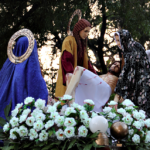
The arrival of Holy Week, which begins with Palm Sunday and Passover, is an occasion to reflect on the inextricable bonds between Judaism and Christianity. But events in 2009 show how fraught this relationship can be, despite decades of successful dialogue.
Background
Pope Benedict XVI’s decision to lift the excommunications of four traditionalist bishops, one of whom sharply minimizes the extent of the Holocaust, was especially grating to Jews. It was in the midst of a series of actions by the pontiff that have upset the Jewish community and raised concerns about Jewish-Catholic dialogue.
The German pope’s trip to Israel in May 2009 was a closely watched development in this story — and the perfect news hook. Meanwhile, some mainline Protestants were long upset with Israel’s handling of the Palestinian conflict, and the Israeli army’s incursion into Gaza deepened those disagreements. ReligionLink has a number of editions on the relationship between Middle East politics and American Christianity.
As you look for Holy Week and Passover stories, consider exploring the history of these divisions, and where they may develop from here. The story has both political and theological strands, which are often intertwined, but also confused.
In her book, Augustine and the Jews: A Christian Defense of Jews and Judaism, Paula Fredriksen of Boston University argues that the polemic against Jews began as an intra-Jewish debate between traditional Jews and Jewish followers of Jesus. As Fredriksen says in this Vision.org interview, only later, after the conversion of Constantine and the adoption of Christianity as the official religion of the Roman Empire, did the battle lines emerge as between Jews and Christians. The Apostle Paul wouldn’t have recognized this pitched battle, she says — even after he accepted Jesus as the Messiah, he still saw himself as a Jew.
Amy-Jill Levine, a scholar of early Christianity at Vanderbilt University and author of The Misunderstood Jew: The Church and the Scandal of the Jewish Jesus, offers her own A-Z list of how to avoid interfaith conflict. A YouTube video of a lecture explores her reassessment of Jewish-Christian relations.
Another window into the story is the ubiquitous seder, or Passover meal, that evangelical Christians hold in the days before Easter. While evangelical Christian relations with Jews have improved on many levels, as this ReligionLink edition shows, both Jews and Christians often misunderstand each other’s religious and theological traditions. The Christian seder is a recent add-on to Holy Week in which Christians re-enact the Last Supper and foreshadow the Crucifixion. But to Jews, the seder has an altogether different meaning. It is a re-enactment of God’s redemptive act of freeing the Jews from slavery in Egypt. Is the seder an opportunity for dialogue or division?
Finally, Passion plays have historically incited anti-Semitism with their portrayal of Jews as responsible for Jesus’ death. Are there any Passion plays in your area, and how are Jews portrayed in them?
NOTE: The Orthodox observance of Palm Sunday and Easter come one week after their corresponding dates in the Western tradition.