


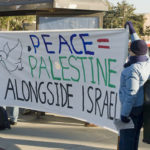
Tensions between Israel and Palestine culminated in deadly attacks on Gaza at the end of 2012. The strikes further hampered direct peace negotiations, which had stalled in 2010 after Israel refused to extend a settlement construction freeze in the East Bank and West Jerusalem.
After Israeli’s 2013 re-election of Prime Minister Benjamin Netanyahu, however, some say Israelis are ready to pursue peace again. But Mahmoud Abbas, president of the Palestinian Authority who has worked to cultivate a nonviolent culture, has grown in unpopularity among his own people, and they have called for his downfall.
Hope among American Jews about the possibility of peace seems to be waning in light of conflicts. Even so, many are seeking ways to actively encourage it again and have backed the White House’s decisions about how to handle Israel.
Palestinian, Israeli and American leaders all have said they believe that two states are inevitable. Although many American Jews would agree, they differ greatly about when, how, where and under what conditions the Palestinian state will emerge.
As they debate these questions, doves in particular encounter one of the most delicate issues in American Jewish politics: How can Jews criticize Israeli policies and still support the Jewish nation? The question involves complex loyalties that are hard for non-Jews to understand. Because of the Nazi Holocaust and the persistence of anti-Semitism internationally, because of Israel’s unique status as the home of a long-homeless people, because it is a refuge for all Jews and because it is ringed by hostile countries, criticizing Israel can be difficult. Jews in America may feel they have no right, since they are not in harm’s way, as Israelis are. And, as one scholar explains, Irish Americans who have criticized Ireland needn’t worry that Ireland will disappear tomorrow; Jews might fear that their criticism of Israel could add fuel to existing anti-Semitism that questions Israel’s right to exist.
Why it matters
What happens in Israel matters to many Americans, Jewish and non-Jewish. By the same token, American opinion and American-Jewish support in particular matter greatly in Israel. Secretary of State John Kerry planned to travel to Israel in 2013 to relaunch peace talks, saying time to create two states was running out and that the U.S. needed to be actively involved in the process.
Jews make up about 2 percent of the U.S. population (estimated at 6.5 million, the American Jewish population, from Orthodox to Reform to unaffiliated, is the world’s largest), but the pro-Israel lobby is hugely influential on American policy. Its alliance with politically important evangelicals even further leverages the pro-Israel political perspective in Washington.
Questions for reporters
Now is an opportune time to ask Jews of various affiliations as well as nonreligious and nonpracticing Jews what connection they feel to Israel and how they view the peace movement. Does conflict in Gaza between Israelis and Palestinians affect their views? Do they believe that Jews should refrain from criticizing Israel?
A cautionary note: Experts urge reporters to refrain from generalizing on the basis of interviews. There is no “typical” Jewish response to Israeli government policies. In fact, Jewish leaders say that few American Jews are particularly knowledgeable about Israeli-Palestinian affairs. Since little research has been done, anyone who tells you “the community” feels this way or that is probably voicing an unsupported if passionate personal opinion.
Programs sending Jewish youngsters to study or live in Israel strengthen ties. After the second intifada began in 2000, such programs were mostly curtailed. Many have started up again. Ask synagogue and summer camp youth programs and Hillel, the Jewish college campus organization, about their participation in such programs. Interview participants and their families about their ties to Israel and their views on the Israeli government’s approach to peace.
Most medium-size American communities and many small ones have a synagogue or Jewish congregation. Are rabbis or congregations engaging the question of how to make peace and whether to pressure Israel or press the American government on issues relating to Israel?
At a time when the American Jewish community is concerned about sustaining its numbers and community leaders seek to keep Jews identifying and affiliating with their community, what part does Israel play? Does Israel’s existence make American Jews feel safer and more closely tied? Do Israeli policies toward Palestinians alienate American Jews?
Ask Jews how they are affected by discussions among churches and other agencies about divesting from Caterpillar Inc. and other firms whose products are used in the Israeli occupation of occupied territories.
National sources
-
Steve Masters
Steve Masters is president of Brit Tzedek v’Shalom Jewish Alliance for Justice and Peace, an American Jewish organization that, among other things, has pushed the White House, through an Internet petition drive, to get the Palestinians and Israel to negotiate. He was present for the signing of the Geneva Accord and has lived in Israel.
- Some information on Brit Tzedek v’Shalom’s local chapters is online.
- Joined in coalition with Brit Tzedek are other American peace-oriented organizations, including Habonim Dror, a progressive labor Zionist youth movement based in New York; Americans For Peace Now; Meretz USA, a progressive Zionist organization affiliated with the Social Democratic Israel political party; and the Parents Circle-Families Forum, begun by bereaved families supporting peace, reconciliation and tolerance.
-
Anna Greenberg
Anna Greenberg is a senior vice president and leading pollster for the Democratic polling firm Greenberg Quinlan Rosner Research, based in Washington, D.C.
-
Ethan Felson
Ethan Felson is vice president and general counsel of the Jewish Council for Public Affairs.
-
John C. Green
John C. Green is a senior fellow at the Pew Research Center’s Forum on Religion & Public Life, specializing in religion and American politics. He also serves as interim university president, director of the Ray C. Bliss Institute of Applied Politics and distinguished professor of political science at the University of Akron.
-
Americans for Peace Now
Americans for Peace Now, founded in 1981, calls itself the leading U.S. advocate for peace in the Middle East. It works to educate Americans and engage the U.S. political process as well as to support Peace Now, the leading Israeli peace organization.
-
Jack Wertheimer
Jack Wertheimer is the Joseph and Martha Mendelson Professor of American Jewish History at the Jewish Theological Seminary in New York City. The seminary is the central educational institution of the Conservative movement in Judaism. Among the dozen books Wertheimer has authored or edited are A People Divided: Judaism in Contemporary America, Jews in the Center: Conservative Synagogues and Their Members and Jewish Religious Leadership: Image and Reality.
-
Paul Burstein
Paul Burstein is chairman of the Jewish studies program at the University of Washington in Seattle. He is an expert on the American Jewish community.
-
Michael Lerner
Rabbi Michael Lerner is editor of Tikkun magazine and founder of the Tikkun Community, a peace and social justice movement. He is also a co-founder The Network of Spiritual Progressives.
-
Jewish Peace Fellowship
The Jewish Peace Fellowship is based in Nyack, N.Y. It was begun in 1941 to defend the rights of conscientious objectors.
-
Jewish Peace Lobby
The Jewish Peace Lobby, based in Silver Spring, Md., is focused on influencing American foreign policy toward peace. Contact its president, Jerome Segal.
-
American Jewish Committee
The American Jewish Committee is an international think tank and advocacy organization that works to identify and fight antisemitism and bigotry, protect human rights and protect Israel and Jewish life everywhere. Its executive director is Ted Deutch. Contact via Jon Schweitzer, managing director of marketing and communications.
-
Coalition of Women for Peace
The Coalition of Women for Peace comprises a number of organizations working for Israeli-Palestinian peace.
-
David Saperstein
David Saperstein is an American rabbi, lawyer and Jewish community leader who served as U.S. ambassador-at-large for international religious freedom from 2015-2017. He previously served as the director and chief legal counsel at the Union for Reform Judaism‘s Religious Action Center for more than 40 years and as a commissioner at the U.S. Commission on International Religious Freedom. He is one of the founders of the Multi-Faith Neighbors Network, which seeks to build mutual trust and respect among faith leaders through civic engagement, authentic relationships and honest dialogue leading to resilient, compassionate and flourishing communities.
Background
After Camp David negotiations failed in 2000 between Arafat and then-Israeli Prime Minister Ehud Barak and intifada violence renewed, the so-called peace camp fell largely quiet in both the United States and Israel. Even committed Jewish doves came to believe that Arafat would not or could not negotiate credibly on behalf of Palestinians. Now, with Arafat’s death, with Israel trying to disengage from the Gaza Strip and a sense that, if a Palestinian state doesn’t form, higher Arab birth rates will eventually make Jews a minority in Israel, some Jews have become more vocal about how to make peace. Still, the peace camp today is on the fringes of Israeli society. It is probably less marginalized among American Jews.
-
“Because They are Jews”
Read “Because They are Jews,” by Beliefnet columnist Rabbi David Wolpe, on anti-Semitism and criticism of Israel.
-
“Marcia Freedman talks peace”
Read “Marcia Freedman talks peace,” published in the Seattle Jewish Transcript online.
-
“Lapid to ‘Time’: Peace made with foes, not friends”
Read a Feb. 1, 2013, article in the Jerusalem Post about Yesh Atid party leader Yair Lapid advocating for resuming peace talks with Palestine.
-
“On Obama’s Israel trip, ideas yes, demands no”
Read a Feb. 7, 2013, article about Obama’s planned trip to Israel to revive the peace process and continue to build his relationship with Prime Minister Benjamin Netanyahu.
-
“Use With Care” handbook
The International Press Institute has prepared a handbook for journalists, titled “Use With Care: A Reporter’s Glossary of Loaded Language in the Israeli-Palestinian Conflict.” It’s available in print or PDF form (registration required) and includes suggested alternatives to problematic terms.
Research
Little reliable polling has been done directly addressing Jewish attitudes toward Israel. Among American Jews, opinions and degree and type of religious participation are enormously diverse, making it impossible to generalize. Reform congregations may be more likely to embrace the peace movement. Surveys show that most Jews feel some tie to Israel. Fear of anti-Semitism and protectiveness about Israel are intrinsically linked. As one Jewish leader says: You’ve got to have a place you can run to if things get bad, and it’s always gotten bad, wherever we’ve lived.
Stronger attachments to Israel are more likely among the more observant, with active ties to Jewish institutions, and those may inspire less willingness to question Israeli policies.
-
“Demographic study sparks debate”
Read “Demographic study sparks debate,” a Sept. 20, 2000, Jewish Telegraphic Agency article posted at Zipple.com. It discusses findings of a team of scholars from Hebrew University, predicting that in the next 80 years, America’s Jewish population will decline by one-third to 3.8 million if current fertility rates and migration patterns continue.
-
“Still Connected: American Jewish Attitudes about Israel”
Read an August 2010 study by the Maurice and Marilyn Cohen Center for Modern Jewish Studies at Brandeis University about how American Jews feel about Israel.
-
“Jewish Agency: Don’t sugar-coat Israel”
Read a Jan. 31, 2013, article from the Jerusalem Post about attitudes about Israel among young Americans.
Anti-Semitism
Many Jews believe that Israel’s policy of building settlements in the occupied territories endangers Israel, yet they are reluctant to criticize Israel. Sociologist Paul Burstein, chairman of the Jewish studies program at the University of Washington, blames the anxiety many Jews feel for their safety. People from other backgrounds have not experienced the existential threat that Jews feel about Israel’s neighboring countries and radical Palestinian factions threatening to eradicate Israel and its people, Burstein says. Many Americans dismiss these threats as rhetorical exaggeration, he says, but given history, the anxiety is not unfounded. Isolated examples of anti-Semitism remind some Jews who are on edge of previous traumas, Burstein says. After the 1999 shootings at the North Valley Jewish Community Center in Granada Hills, Calif., Jewish communities around the country began to hire guards and build barricades at schools, synagogues and community centers.
-
Zionist Organization of America
Zionist Organization of America advocates for Israel, in Washington, D.C., on college campuses and in communities. It also counters anti-Israel bias in media and on campus. It was started in 1897 to help found a Jewish state in Palestine. Past presidents have included Supreme Court Justice Louis Brandeis and Rabbi Abba Hillel Silver. Contact ZOA National President Morton A. Klein.
-
Jewish Council for Public Affairs
The Jewish Council for Public Affairs (formerly the American Jewish Public Affairs Committee), based in New York with offices in Washington, represents the organized American Jewish community, particularly in protecting the rights of Jews everywhere and in supporting a just and pluralistic American democracy.
Geneva Accord
In 2003, frustrated with the pace at which their respective governments were approaching peace negotiations, experienced negotiators from the Palestinian Authority and from the Israeli opposition party met quietly and signed an unofficial Draft Permanent Status Agreement (or Geneva Accord), finding solutions to most of the tough issues that obstructed previous official negotiations. Liberal Palestinians and Israelis saw it as a model for what could be done. The Geneva Accord was rejected by the Likud government in Israel. Read Wikipedia’s site explaining the accord.
-
“Freelancers Seek Middle East Peace”
Read an Oct. 18, 2003, Associated Press article, “Freelancers Seek Middle East Peace.”
-
“We have done the grunt work of peace”
Read an Oct. 17, 2003, article from The Guardian about Amos Oz’s experience during the drafting of the Geneva Accord.
Divestment
American Jews have been faced with a divestment movement aimed at pressuring Israel to settle with the Palestinians.
-
“Mainline Churches vs. Israel?”
Read a Beliefnet article about Protestant churches contemplating divestment.
-
“Assembly endorses Israel divestment”
Read on the Presbyterian Church (USA) website about the church’s 216th General Assembly approval in July 2004 of a controversial program involving possible “selective, phased divestments” from multinational corporations doing business in Israel. Caterpillar Inc. often is singled out for making bulldozers used to level homes and orchards of Palestinians in the West Bank and the Gaza Strip.
-
“Statement on interfaith relations, peace ministries with Israel”
In September 2004, the Episcopal Church began studying whether to divest from companies helping to cause destruction in Palestine. Other religious groups speaking in favor of divestments are the Roman Catholic Sisters of Loretto and Jewish Voice for Peace, a small Jewish peace group.
-
“From churches, a challenge to Israeli policies”
Read a Dec. 6, 2004, Christian Science Monitor article about Christian churches considering divestment.
-
“Should US churches divest from Israel?”
Read an April 25, 2012, Al Jezeera article about major churches contemplating divesting from Caterpillar Inc. and Motorola Solutions.
Regional sources
State-by-state
-
Zionist Organization of America
Zionist Organization of America advocates for Israel, in Washington, D.C., on college campuses and in communities. It also counters anti-Israel bias in media and on campus. It was started in 1897 to help found a Jewish state in Palestine. Past presidents have included Supreme Court Justice Louis Brandeis and Rabbi Abba Hillel Silver. Contact ZOA National President Morton A. Klein.
State offices are listed and a few have links.
In the Northeast
-
The Massachusetts Council of Churches
The Massachusetts Council of Churches’ website lists Jewish organizations and contacts involved in Middle East peace work.
-
Mark Rosenblum
Historian and Middle East expert Mark Rosenblum directs the Michael Harrington Center at City University of New York’s Queens College. He teaches “The Middle East and America: Clash of Civilizations or Meeting of the Minds,” in which Jewish and Muslim students learn the opposing group’s history in the Middle East conflict and must support the opposing viewpoint. Rosenblum is founder and policy director of Americans for Peace Now and speaks nationally on related subjects.
-
Ellen Lippmann
Ellen Lippmann is founder and rabbi of the Kolot Chayeinu congregation in Brooklyn. The congregation identifies itself as comprising individuals of varying sexual orientations, races, family arrangements, Jewish identities and backgrounds sharing the search for meaningful expression of Judaism.
-
Gerry Serotta
Rabbi Gerry Serotta is a former chair of Rabbis for Human Rights – North America and works as the executive director of Clergy Beyond Borders.
-
Mishkan Shalom
Reconstructionist congregation Mishkan Shalom in the Manayunk-Roxborough section of Philadelphia draws members from all over the area for its commitment to social justice, to the survival of Israel and to the belief that Jews and Palestinians need to recognize and support each other’s right to national self-determination. Contact Rabbi Linda Holtzman.
-
Seeds of Peace
The Seeds of Peace summer camp first convened in Otisfield, Maine, in 1993 to bring Arab and Israeli teenagers together. Today, the camp empowers young leaders from the Middle East and other regions of conflict with leadership skills directed toward reconciliation and coexistence. Contact founding director Tim Wilson.
In the South
-
John S. Friedman
John S. Friedman is rabbi of the Judea Reform Congregation in Durham-Chapel Hill, N.C. He has received awards for his activism in peace and social justice causes. He has been president of Durham Congregations in Action and the Mid-Atlantic Association of Reform Rabbis and has chaired the Interreligious Affairs Committee of the Central Conference of American Rabbis.
-
Liliane Kshensky Baxter
Liliane Kshensky Baxter is director of the Lillian and A.J. Weinberg Center for Holocaust Education at the William Breman Jewish Heritage Museum in Atlanta. Baxter is a member of the executive committee of the national Jewish Peace Fellowship, and she is former national chairwoman of the Fellowship of Reconciliation/USA. She was previously director of Nonviolence Training and Studies at The King Center in Atlanta.
-
Richard Friedman
Richard Friedman, executive director of the Birmingham, Ala., Jewish Federation, can discuss whether the connection to Israel is in any way unique for Jews in the Deep South.
In the Midwest
-
Hands of Peace
Hands of Peace is a summer program in Glenview, Ill., that brings youth from all sides of the Palestinian-Israeli conflict together with American kids from Christian, Islamic and Jewish homes. The Middle Eastern teens receive year-round support to maintain connections when they return home. A trio of congregations (Jewish, Muslim and Christian) founded the camp, which is supported by private donations. Contact Julie Kanak, executive director.
-
Herbert Bronstein
Rabbi Herbert Bronstein is senior scholar at North Shore Congregation Israel, a metropolitan Chicago congregation where he was senior rabbi for some 25 years. He teaches at the religion department at Lake Forest College, is nationally active in the interfaith community and formerly served on the board of the Council for a Parliament of the World’s Religions. Ask him particularly about the difficulties that non-Jews have understanding Jewish fears of anti-Semitism and how those fears shape American support for Israel.
In the West
-
Len and Libby Traubman
Len and Libby Traubman in San Mateo, Calif., began a living room dialogue involving Palestinians, Christians and Jews. Their Call to Dialogue invites others to do the same and offers ideas on how to begin. The Traubmans organized a Children of Abraham dialogue weekend in Duluth, Minn., in fall 2004.
-
James L. Mirel
Rabbi James L. Mirel is chair of the Washington Coalition of Rabbis. He co-authored, with local Muslim and Christian leaders, a Seattle Times column urging moderate Jews, Christians and Muslims to persuade the American government to engage actively in pursuing peace between Israelis and Palestinians. He is rabbi of Temple B’nai Torah (Reform) in Bellevue, Wash.
-
Deborah Brin
Rabbi Deborah Brin and the Nahalat Shalom Jewish community are involved in peace and reconciliation work in Albuquerque, N.M.
-
Muslim-Jewish Peace Walk
Tucson holds an annual Muslim-Jewish Peace Walk. Read an article in the Tucson Weekly previewing a previous event.
Related source guides
-
Jewish-Christian relations after ‘The Passion of the Christ’
-
Jewish-Christian relations: Taking stock at the holidays
-
Crisis in the Holy Land: Israel and the Gaza blockade
-
Religion and peacebuilding
-
Judaism: U.S. experts and organizations
-
Covering Islam and politics
-
Supporting Israel: Jews and U.S. evangelicals
-
Pointers for reporters on disputed issues in the Middle East
-
Middle East turmoil in Egypt: A secular or religious revolt — or both?