


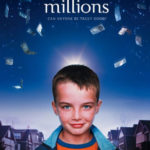
The critically acclaimed Millions heads a list of “religious” films that focus as much on values as saviors and saints.
When Millions director Danny Boyle decided to make a film about an English boy and his relationship with the saints, he wanted to bring the same realism he had achieved in his earlier films about addicts and zombies.
In Millions, which opened in March 2005, a young boy has a vision of a cranky St. Clare smoking a hand-rolled cigarette. But the film is ultimately about his understanding of richness beyond money and his determination to do good.
Films such as Constantine, the recut The Passion of the Christ and The Lord of the Rings Trilogy present overtly religious symbols. Scholars consider Million Dollar Baby and The Sea Inside religious films in part because they grapple with the moral dilemma of assisted suicide. The U.S. Conference of Catholic Bishops’ film office gave both movies an “O” rating – for morally offensive – because they offer sympathetic views of euthanasia.
Other films with implicit religious themes include: Their Eyes Were Watching God (spiritual awakening), The Motorcycle Diaries (spiritual journey), Sideways (search for identity), Shrek 2 (hero myth), Lost in Translation (rite of passage) and I Heart Huckabees (existential angst).
Some scholars say filmmakers have been dealing with the same life and death themes since the dawn of movies. But Virginia Wesleyan College religion professor Eric Michael Mazur sees an ongoing evolution in Jesus films; a focus on religious “enemies,” such as Muslim fundamentalists; a greater interest in the spirit world; and more willingness to accept ambiguity.
Why it Matters
Since the early days of movies, films have reflected how society grapples with questions about the existence of God and the meaning of life. Millions and Million Dollar Baby are among the films that explore religious questions for a new generation of moviegoers, such as: What does it mean to be good? And who has the right to end a life?
Questions for reporters
• What new films raise religious and spiritual themes?
• What themes are most popular?
• How do new films differ from a previous generation in subject matter and point of view?
• How do they reflect societal values?
• How do films portray gods, devils, saints and biblical figures?
• How do they portray devout people?
• How have such films been received by religious leaders and organizations?
• Why are some films considered morally offensive?
• Do religious films have popular appeal with moviegoers?
• Which filmmakers have shown a particular sensitivity to religious subjects?
• Which filmmakers have mishandled or exploited religious themes?
• What new foreign films are dealing with religious themes?
National sources
-
John Lyden
John Lyden became editor of the University of Nebraska-Omaha’s Journal of Religion and Film in 2011. He was professor of religion at Dana College from 1991-2010 and is now director of the Liberal Arts Core at Grand View University in Des Moines, Iowa. Lyden is the author of Film as Religion: Myths, Morals and Rituals and editor of The Routledge Companion to Religion and Film. He says that any popular film that affects people’s understanding of war, life and death is arguably religious. Movies, he says, can function religiously, providing a ritualized form of “meaning-making activity” through stories that express values and beliefs about the world.
-
Eric Michael Mazur
Eric Michael Mazur is a religion professor at Virginia Wesleyan College in Norfolk, where he teaches courses on religion and popular culture and Judaism and film. He is the editor of the Encyclopedia of Religion and Film. He is also co-editor of Religion and Outer Space, a volume exploring religion in and on the final frontier.
-
S. Brent Plate
S. Brent Plate is a professor of religious studies at Hamilton College in Clinton, New York. He has written about religion, art and visual culture. Religions, he notes, discuss the creation of the world, and films work on re-creating the world. He’s interested in how film has “come down” off the screen and infiltrated rituals. His books include A History of Religion in 5-1/2 Objects: Bringing the Spiritual to Its Senses; Religion and Film; The Religion and Film Reader; Blasphemy: Art That Offends; Re-Viewing the Passion: Mel Gibson’s Film and Its Critics; and Representing Religion in World Cinema.
-
George Aichele
George Aichele, professor of philosophy and religion at Adrian College in Adrian, Mich., has written about connections between scripture and film, and about culture, entertainment and the Bible. He’s not so much interested in “Bible movies” that focus on overtly religious or theological themes. He’s interested in the points where biblical text, images, languages and themes appear in popular movies that are otherwise quite “secular,” such as Pleasantville and Minority Report.
-
Diane Apostolos-Cappadona
Diane Apostolos-Cappadona, professor of religious art and cultural history at Georgetown University, wrote about “re-viewing” Mel Gibson’s The Passion of the Christ and images of women in contemporary religious film.
-
Richard A. Blake
The Rev. Richard A. Blake, co-director of film studies at Boston College, is a film historian and author of Afterimage: The Indelible Catholic Imagination of Six American Filmmakers. Much of his writing has centered on religious themes and imagery in mainstream filmmaking.
Background
-
The Journal of Religion & Film
The Journal of Religion & Film is a peer reviewed journal which is committed to the study of connections between the medium of film and the phenomena of religion, however those are defined. It encourages multiple approaches to the study of religion and film, including (but not limited to) the analysis of how religious traditions are portrayed in films; exploration of the religious concepts that may be found or utilized in the interpretation of films; study of how the religious ideals and background of the filmmakers may have influenced them; and analysis of how films themselves may operate “religiously” for viewers.
-
The Journal of Religion and Popular Culture
The Journal of Religion and Popular Culture is a web-based, peer-reviewed journal committed to the academic exploration, analysis and interpretation, from a range of disciplinary perspectives, of the interrelations and interactions between religion and religious expression and popular culture, broadly defined as the products of contemporary mass culture. The journal is based in Canada, but international in scope, and open to explorations of religion and popular culture in a variety of nationalities and cultures. It is edited by Mary Ann Beavis at the University of Saskatchewan in Saskatoon.
-
Movie Theology: Movie Reviews & Resources
The Movie Theology website lists movie reviews, movie theology blogs, film discussion groups and articles on faith and film.
-
USCCB Office of Film and Broadcasting
Read movie reviews on the U.S. Conference of Catholic Bishops’ Office of Film and Broadcasting website.
-
Sister Rose Pacatte’s movie blog
Read the movie blog of Sister Rose Pacatte, director of the Pauline Center for Media Studies at Culver City, Calif.
-
Christianity Today’s movie reviews
Reviews, interviews, news, commentaries, best-of lists, filmmakers of faith, faith forum.
-
David Bruce
David Bruce, an ordained minister, is the webmaster of Hollywood Jesus. Hollywood Jesus posts movie reviews and explores the “profound meaning” behind film, music and pop culture from a Christian point of view.
-
INTERFILM
A Germany-based international network that brings together individuals and institutions interested in film and theology.
-
Reel Spirituality
Reel Spirituality seeks to simultaneously raise visual and spiritual literacy. Image-driven, educationally-focused, and spiritually-centered, Reel Spirituality brings together filmmakers and film-viewers, Christian leaders and laity, scholars and students for dialogue between our culture’s primary stories, whether in film or television, and the Christian faith.
Regional sources
In the Northeast
-
John Michalczyk
John Michalczyk, documentary filmmaker and co-director of film studies at Boston College, is interested in the intersection of politics and religions during conflict. He has filmed documentaries on conflict resolution in Bosnia and Croatia, South Africa, Jerusalem and Northern Ireland; Jews, Christians and the Holocaust; Nazi medicine; Boston’s Jews and Irish; and the dilemma of interfaith holidays.
-
Bryan Stone
Bryan Stone serves as associate dean for academic affairs, director of the Center for Practical Theology and a professor of evangelism at Boston University’s School of Theology. He researches congregational development, urban ministry and theology and popular culture.
-
Omer Bartov
Omer Bartov, Brown University professor of European history, is the author of The “Jew” in Cinema: From the Golem to Don’t Touch My Holocaust (Indiana University Press, 2005). The book looks at how stereotypical portrayals of the “Jew” have informed European, American and Israeli cinema since the 1920s. In fall 2005, 200 students took his class, Modern Genocide and Other Crimes Against Humanity.
-
M. Gail Hamner
M. Gail Hamner, Syracuse University religion professor, specializes in religion and culture, with teaching interests in religion and film, Christianity and American culture, religion and literature, and feminist theory and the study of religion.
-
Björn Krondorfer
Björn Krondorfer is a professor of religious studies at Northern Arizona University in Flagstaff. He is an expert on Western religious traditions and has particular interests in cultural studies, Holocaust studies and gender studies. He is also an expert on Madonna images in both religion and popular culture.
In the South
-
Robert D. Benne
Robert D. Benne is professor emeritus and research associate in the Department of Religion/Philosophy at Roanoke College in Salem, Va. He has written about visions of life through film.
-
Conrad Ostwalt
Conrad Ostwalt is Department Chair of Philosophy and Religion at Appalachian State University in Boone, N.C. He co-edited a book with Joel Martin, Screening the Sacred: Religion, Myth and Ideology in Popular American Film (Westview Press, 1995). He has written extensively about religion in the movies, with an emphasis on depictions of the Apocalypse, and is the author of Secular Steeples: Popular Culture and the Religious Imagination (Trinity Press International, 2003).
-
Richard Walsh
Richard Walsh, professor of religion at Methodist University in Fayetteville, N.C., writes about portrayals of Jesus in film. He says there have always been implicitly Christian movies because the Christian narrative and vision of life is so deeply ingrained. Walsh is author of Reading the Gospels in the Dark: Portrayals of Jesus in Film (Trinity Press International, 2003), which compares Jesus films to the canonical Gospels, and Finding St. Paul in Film (2006).
-
John R. May
John R. May, professor of English and religious studies at Louisiana State University, has written about Hollywood and religion, contemporary theories on the interpretation of religious film and religious visions in American classics. He is editor of the books New Image of Religious Film and Image & Likeness: Religious Visions in American Film Classics.
-
Ted Trost
Ted Trost, University of Alabama American religions professor, has taught a course about religious themes and rituals in popular film.
-
Frances Flannery
Frances Flannery is the director of the Center for the Interdisciplinary Study of Terrorism and Peace (CISTP) and an associate professor of religion at James Madison University in Harrisonburg, Va. Her current area of study is apocalypticism and its link to terrorism. She also teaches courses on the Hebrew Bible, world religions, religion and mysticism in early Judaism and Christianity. She serves on the editorial board of the peer-reviewed Journal of Religion and Film.
In the Midwest
-
Richard C. Stern
The Rev. Richard C. Stern, homiletics professor at St. Meinrad School of Theology in St. Meinrad, Ind., is co-author of the book Savior on the Silver Screen (Paulist Press, 1999).
-
Roy Anker
Roy Anker, a longtime professor of English at Calvin College in Grand Rapids, Mich., is the author of Beautiful Light: Religious Meaning in Film. He has also written about religion and the films of M. Night Shyamalan and the use of artificial intelligence in the films of Steven Spielberg.
-
Anthony Burke Smith
Anthony Burke Smith, associate professor of religious studies at the University of Dayton, is author of The Look of Catholics: Portrayals in Popular Culture from the Great Depression to the Cold War. He has written about the cultural and political role of Catholics in movies, television and photojournalism in debates about American identity.
In the West
-
Richard Hecht
Richard Hecht, religious studies professor at University of California, Santa Barbara, has taught a course about religious themes in American films.
-
Amir Hussain
Amir Hussain is professor of theological studies at Loyola Marymount University in Los Angeles. He is a former editor of the Journal of the American Academy of Religion. His research focuses on Islam in North America, with additional expertise in religion and music, religion and literature, religion and film and Islam and Christian-Muslim relations.
-
Paul V.M. Flesher
Paul V.M. Flesher, University of Wyoming professor of religious studies, teaches a course on religion and film. He and Robert Torry are co-authors of Film and Religion: A Textbook (2007). He is also an expert on Judaism of the Rabbinic period and early synagogues.
-
Andrew Flescher
Andrew Flescher, religion professor at California State University, Chico, has taught a course on religion and film that looks at religion and self in contemporary American society; religion, redemption and recovery; and religion and ethnicity. He also directs the Center for Applied and Professional Ethics, where he focuses on religion, ethics and society. He is the author of The Altruistic Species: Scientific, Philosophical and Religious Perspectives of Human Benevolence.
-
Gregory A. Robbins
Gregory A. Robbins, University of Denver religious studies professor, has taught the course “Jesus on the Silver Screen.”
-
Erin Runions
Erin Runions is Associate Professor in the Department of Religious Studies at Pomona College in California. She is a specialist in the Hebrew Bible, which she reads from the perspective of cultural studies and gender and sexuality studies. She has written about the connections between scripture and film.
Related source guides
-
Gospel of dollars: Is Hollywood becoming Holywood?
-
Hollywood translates The Da Vinci Code
-
Movies blend religious and moral themes
-
Hindu chic? From the yoga craze to the movie ‘Eat Pray Love’
-
Jewish-Christian relations after ‘The Passion of the Christ’
-
Faith and film: ‘Holywood’ goes to the Oscars
-
And the winner is…!: God and the 81st Annual Academy Awards