


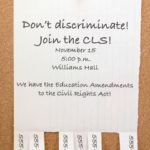
A conflict on college campuses across the country pits student religious groups against school anti-discrimination policies. The groups want waivers from the policies so they can reject members or leaders who don’t subscribe to their beliefs, particularly on homosexuality. Student groups, often with help from conservative legal organizations, file lawsuits seeking exemptions from the policies. Some colleges settle, but several head to court.
The groups, usually Christian organizations, must follow anti-discrimination rules to earn campus recognition, meeting space and funds from student activity fees. Yet some maintain that they must discriminate because of scriptural injunctions against, for example, homosexual conduct. At stake, say supporters of these groups, are freedom of religion and the right to free association.
Waiver opponents – including gay rights organizations and many campus administrators – say that what is at stake is civil rights for all. The right of access to all campus facilities by minorities, those with handicaps, lesbians and gays, etc. began with the civil rights movement in the 1960s.
Why it matters
This issue involves cherished American rights, those of religious liberty (in the First Amendment) and equal protection under the law (14th Amendment). Also, the conflict illustrates a movement away from liberal, secular values on campuses in the 1970s through the ’90s, and the strength and new assertiveness of conservative Christian organizations. Opponents of waivers charge that there is a larger agenda at play and that behind these challenges is an anti-gay movement to dismantle anti-discrimination laws and policies.
Questions for reporters
- Some Christian students complain of a hostile atmosphere toward religion on campus. Ask religious students if they experience anti-religious bias.
- Do religious student leaders at campuses in your coverage area believe that placing restrictions on gays’ and lesbians’ behavior is important in selecting members? Do they find campus anti-discrimination policies an obstacle to their religious practice? Lawyers for the religious clubs counter critics by asking whether gay, lesbian and transgender student groups would feel justified in excluding vehemently homophobic students.
- Most campus religious groups have a history of abiding with anti-discrimination policies. Why, then, do some chafe under them, and why now?
Background
Title IX of the 1972 Education Amendments to the Civil Rights Act requires campuses receiving federal funds to have anti-discrimination policies.
For decades, many campus student religious groups signed anti-discrimination policies but quietly continued to discriminate in what one legal expert calls a “gentleman’s agreement.” He likened it to sororities and fraternities choosing members based on gender, despite campus rules prohibiting discrimination by gender. What has changed is that some students have filed complaints, and campus authorities and religious legal groups have pushed the issue. Pressure has, in many cases, won waivers for student groups.
Typical of the controversial passages in student groups’ constitutions is this one, by the ReJOYce in Jesus Campus Fellowship at the Milwaukee School of Engineering: “A voting member of this organization shall not commit those acts which are expressly forbidden in Scripture, including idolatry, premarital or extramarital sex, homosexual behavior, drunkenness, coveting, theft, profanity, occult practices and dishonesty.” The ReJOYce constitution cites as authority: Exodus 20:1-17; Leviticus 18:22; Deuteronomy 18:10-11; Romans 1:18-32; 1 Corinthians 5:9-13 and 6:18-19; and Ephesians 5:1-12. Read a letter by lawyers for the Foundation for Individual Rights in Education to the president of the Milwaukee School of Engineering, outlining ReJOYce’s legal position.
Often, the student groups require chastity for all single members, without distinguishing between gay and straight members. But critics say that is still discriminatory, since gays and lesbians can’t marry people of their own gender and so could never escape the requirement for abstinence.
No federal anti-discrimination law exists. Some states have anti-discrimination statutes. Most colleges and universities have anti-discrimination policies.
University recognition has its privileges, which is why the student Christian groups say they are pressing the point. Typical benefits involve funding from student fees. Here is a list of benefits for recognized campus clubs at Arizona State University: inclusion in university promotional materials, some free photocopying and posters, rental of sound systems and other equipment, an email account, lockers, mailbox and storage, eligibility for funding through students’ associations, use of campus buildings for meetings and events, server space for a website.
History
The first notable clash between a student club and campus anti-discrimination policies was apparently in 2000 at Tufts University in Medford, Mass. A student had been a member of the Tufts Christian Fellowship for three years, having struggled to decide whether she was gay. She decided that she was a lesbian and wanted to become part of senior leadership. The group rejected her bid, partly because of her sexual orientation and partly because she hadn’t participated in enough activities, said Bruce Reitman, Tufts dean of students. The woman complained under the school’s anti-discrimination policy. The fellowship was ejected from campus by a student panel. But, then the panel, at the urging of a faculty committee, instead put the fellowship on a year’s probation, requiring it to rewrite its leadership requirements. The woman withdrew her complaint.
Read statements from the campus group and from the university published at Beliefnet.com.
-
“A Christian Fellowship’s Ban on Gay Leaders Splits 2 Campuses”
Read a May 12, 2000, Chronicle of Higher Education article describing how nondiscrimination clauses affected a religious group at Tufts University.
-
The Pew Forum on Religion & Public Life: Education
The Pew Forum on Religion & Public Life provides a resource page on issues relating to religion and public schools, such as the evolution debate.
Campus conflicts
Although dozens of such conflicts have arisen on campuses across the country, they have usually been settled quietly. But several schools have pushed the issue toward court. These cases include:
- Sinclair Community College, Dayton, Ohio. A student group sued the college after campus police banned religious signs at campus events. The First Amendment lawsuit went to the U.S. District Court for the Southern District of Ohio and was settled after the college agreed to amend its policy.
- Pennsylvania State University, University Park. In an interim mediated settlement reached March 30, 2005, in the case of DiscipleMakers Inc. v. Graham B. Spanier, et al, the university allowed DiscipleMakers to stay on campus until the end of the year. The group would not comply with Penn State’s nondiscrimination policy required for university recognition. The club’s constitution required leaders to follow conservative Christian guidelines, including a prohibition on gay sex.
- University of California, Hastings College of Law. Evangelical students filed suit in U.S. District Court in San Francisco over the law school’s refusal to recognize a Christian Legal Society chapter. The chapter requires members to sign a statement of faith that effectively bars anyone who engages in gay sex or believes that it isn’t sinful. The case made it to the U.S. Supreme Court in 2010, where the court ruled that a university can require its student groups to allow any person to be a voting member or officer regardless of his or her beliefs.
- University of North Carolina at Chapel Hill. A small Christian fraternity, Alpha Iota Omega, was stripped of recognition in fall 2003 when the group declined to add a nondiscrimination clause to its constitution. AIO says the clause would forbid it from considering religion in choosing members. In the first court ruling in such a case, a federal judge on March 2, 2005, issued an injunction against the university. Read a March 4, 2005, News & Observer story. Read the injunction at the site of the Foundation for Individual Rights in Education, which is helping the fraternity. Read a Feb. 24, 2005, story from the university paper The Daily Tar Heel.
- Southern Illinois University School of Law. The Christian Legal Society filed suit in U.S. District Court in Illinois after university officials revoked the chapter’s registered status. A student had filed a complaint claiming that CLS chapter membership and leadership policies violated university nondiscrimination policy. The lawsuit, which ended up in the U.S. Court of Appeals, contended the university violated the chapter’s First Amendment rights of expressive association, free speech and free exercise of religion.In 2006, the court required the university to recognize the student group.
Relevant legal precedents
Attorneys on both sides cite four Supreme Court decisions as relevant:
- Widmar v. Vincent. Read the case at Findlaw. On Dec. 8, 1981, the court ruled 8-1 that the University of Missouri at Kansas City could not refuse recognition to a Christian student group because of its religious orientation. Those beliefs, the court ruled, are protected free speech. The argument that the constitutional separation of church and state prevented public institutions from recognizing or supporting religious student groups was dissolved by the rulings in Widmar and in Rosenberger v. Rector & Visitors of the University of Virginia.
- Rosenberger v. Rector & Visitors of the University of Virginia. In 1995, the high court ruled 5-4 that the school couldn’t deny student-fee funds to a Christian newspaper because of its religious content.
- Boy Scouts of America et al v. Dale.
- In 2000, the court ruled 5-4 that a private organization may limit its leadership to those whose beliefs are consistent with the organization’s values and mission.
- Roberts v. United States Jaycees. See a 1984 Michigan Law Review article, posted by University of Missouri law professor Douglas Linder. The Roberts decision upheld a Minnesota court’s ruling requiring the service organization to admit women and addressed issues defining the right of association. This case tested membership organizations’ right of association.
Articles and Internet references
-
“Campus Christians: Not always at ease”
Read a Jan. 25, 2005, Christian Science Monitor article, “Campus Christians: Not always at ease,” about Christians feeling as though their faith is mocked in the classroom.
-
“Choosing Their Flock”
Read a Jan. 28, 2005, article, “Choosing Their Flock,” on the Chronicle website. Contact author Burton Bollag.
National sources
In support of waivers
-
Foundation for Individual Rights in Education
The Foundation for Individual Rights in Education is a nonprofit educational foundation whose mission is to defend individual rights “at America’s increasingly repressive and partisan colleges and universities.” FIRE attorneys often help student groups rewrite their constitutions to make them legally defensible and represent student groups in court. Download FIRE’s guides to campus rights. Contact president Greg Lukianoff.
-
Alliance Defending Freedom
The Alliance Defending Freedom is a watchdog group that was founded by Bill Bright, the evangelical minister who started Campus Crusade for Christ, and several other evangelical leaders. It concerns itself with three main issues: religious liberty, “sanctity of life” and traditional marriage. It is based in Scottsdale, Arizona, and Kristen Waggoner is CEO, president and general counsel. Use the website for media.
-
Christian Legal Society
The Christian Legal Society is a nonprofit Christian organization headquartered in Virginia that consists of lawyers, judges, law professors and law students. Its members are bound to follow the “commandment of Jesus” and to “seek justice with the love of God.”
-
Douglas Kmiec
Professor Douglas Kmiec holds the endowed chair in constitutional law at Pepperdine Law School in California. He co-authored three books on the Constitution. It is unconstitutional for state entities to impose religious nondiscrimination policies, in Kmiec’s view, as they single out religious viewpoint for disfavor or target religious practice to discriminate against believers without a compelling reason for doing so. Ask Kmiec to discuss what he considers to be constitutionally valid alternatives for meeting the goal of nondiscrimination.
Against waivers (or skeptical of them)
-
Winnifred Fallers Sullivan
Winnifred Fallers Sullivan chairs the department of religious studies and is an affiliate professor of law at Indiana University in Bloomington. She is interested in the legal regulation of religion in modern pluralistic societies. She wrote The Impossibility of Religious Freedom. Ask her to discuss the history of religious groups that are pressing for rights of religion over secularity, a movement she dates to the 1988 case Employment Division v. Smith.
-
Human Rights Campaign
The Human Rights Campaign is the country’s largest civil rights organization working for sexual equality. Its Religion & Faith Program supports programming efforts in many different groups and also offers its own resources and event support for religious LGBT advocacy.
-
Robert M. O’Neil
Robert M. O’Neil is professor of law emeritus at the University of Virginia Law School. His previous career as a campus administrator included stints as president at the University of Virginia, provost of the University of Cincinnati, vice president of Indiana University and president of the statewide University of Wisconsin system. With background in both the First Amendment and university administration, his is a unique perspective. O’Neil is generally skeptical of waivers but is a proponent of Free Exercise and of state religious freedom laws.
Neutral
-
Sheldon “Shelley” E. Steinbach
Sheldon “Shelley” E. Steinbach is former vice president and general counsel for the American Council on Education in Washington, D.C., and works for Education Industry Reporter. He says campuses must ensure that their nondiscrimination policies are applied fairly and consistently. The conflict between religious rights and individual rights is difficult and not clear-cut, he says.
Regional sources
State by state
Cases
No complete list of cases is available online. For a partial list, see:
- The Foundation for Individual Rights in Education’s case archive
Resources
- See a list of law school chapters of the Christian Legal Society.
- See listings of state anti-discrimination laws and laws and policies affecting schools and educational institutions at the Human Rights Campaign site. To reach HRC representatives on campuses across the country, contact Michael Cole-Schwartz, director of communications, 202-628-4160.
-
InterVarsity Christian Fellowship/USA
InterVarsity Christian Fellowship/USA, based in Madison, Wis., is an evangelical campus mission serving some 35,000 students and faculty at about 560 colleges and universities. See a map of local chapters. Contact media coordinator Gordon Govier via the website.
In the Northeast
-
Bruce Reitman
Ask Bruce Reitman, dean of student affairs at Tufts University in Medford, Mass., about the problems for universities when they are asked to choose between the rights of gays and lesbians and freedom of association for religious groups. The meeting of such divergent opinions is an opportunity for students and faculty to enrich a university setting through debate and inquiry, he says.
-
Harvey Silverglate
Harvey Silverglate, a Boston attorney, is co-founder of FIRE. He co-authored The Shadow University: The Betrayal of Liberty on America’s Campuses (Harper Perennial, 1999) and FIRE’s Guide to Free Speech on Campus (Foundation for Individual Rights in Education, 2005).
-
Robert A. Destro
Robert A. Destro is a law professor and founding director of the Interdisciplinary Program in Law and Religion at the Catholic University of America, in Washington, D.C. He is an expert in freedom of religion, constitutional law (separation of powers), international human rights, freedom of speech, freedom of association, bioethics, marriage law and civil rights. Destro served as a member of the U.S. Commission on Civil Rights from 1983 to 1989.
-
Janet R. Jakobsen
Janet R. Jakobsen is associate professor and director of the Center for Research on Women at Barnard College in Columbia University, New York. She co-authored Love the Sin: Sexual Regulation and the Limits of Religious Tolerance (Beacon Press, 2004).
-
Nadine Strossen
Nadine Strossen is a professor at New York Law School and former president of the American Civil Liberties Union. She has written extensively about constitutional law and civil liberties and about students’ rights.
-
Robert Smith
Robert Smith is the director of the Center for Ethics and Religious Affairs at Penn State University.
-
Paul Finkelman
Paul Finkelman is a professor of law and public policy at Albany Law School in New York. He is an expert in constitutional history and constitutional law, freedom of religion, the law of slavery, civil liberties and the American Civil War, baseball and the law and religious monuments in public spaces. He has written prolifically about the First Amendment and religion, including Landmark Decisions of the United States Supreme Court (with Melvin I. Urofsky).
In the South
-
Jon Gould
Jon Gould is director of the Center for Justice, Law and Society at George Mason University in Virginia and author of Speak No Evil: The Triumph of Hate Speech Regulation (University of Chicago Press, forthcoming 2005).
-
John Witte Jr.
John Witte Jr. directs the Center for the Study of Law and Religion at Emory University, where he also teaches law. He is an expert on legal issues related to marriage, family, Christianity and religious freedom. His books include Church, State and Family: Reconciling Traditional Teachings and Modern Liberties and Religion and the American Constitutional Experiment.
-
Leslie Strohm
Leslie Strohm is vice chancellor and general counsel for the University of North Carolina at Chapel Hill, which denied recognition to a Christian fraternity that wouldn’t sign the university’s nondiscrimination policy.
-
David Hudson
David Hudson is an adjunct professor of law at Vanderbilt University and scholar on the staff of the First Amendment Center at the university’s Nashville campus. He is an expert on First Amendment and church-state issues.
-
Lisa Shaw Roy
Lisa Shaw Roy is an associate professor of law at the University of Mississippi in Oxford. She teaches law and religion and has published law review articles concerning religious speech in public schools and the interpretation of the Establishment Clause of the First Amendment.
-
Randall Ellis
Randall Ellis is vice president of public affairs for Legacy Health Community Services and former executive director of the Lesbian/Gay Rights Lobby of Texas. Ask him to discuss whether religious groups’ efforts to be excluded from nondiscrimination policies have affected campus attitudes toward gays and lesbians.
-
Frank Guliuzza III
Frank Guliuzza III is a professor of government at Patrick Henry College in Purcellville, Va. He has written on issues of religion and the First Amendment.
In the Midwest
- In 2004, Ohio State University retreated from its demand that campus-recognized religious groups abide by the campus nondiscrimination policy. Thomas W. Condit of Milford, Ohio, participated in negotiations as attorney for the CLS chapter. Contact 513-965-9260. Trial attorney Kathleen M. Trafford represented the university in court before the settlement. Contact 614-227-1915.
-
Andrew Koppelman
Andrew Koppelman is a professor at Northwestern University Law School in Evanston, Ill., where he teaches law and political science. His books include Antidiscrimination Law and Social Equality (Yale University Press, 1996), The Gay Rights Question in Contemporary American Law (University of Chicago Press, 2002) and Defending American Religious Neutrality (Harvard University Press, 2012). His position is that waivers are appropriate and that anti-discrimination rules are being applied “mindlessly.”
-
Kevin den Dulk
Kevin den Dulk teaches political science at Calvin College in Grand Rapids, Mich. His interests include American politics, religion and politics cross-nationally, public law and courts and political theory. He has written about free speech and religious liberty and about the legal mobilization of conservative Christians in the United States. He is the co-author of Religion and Politics in America: Faith, Culture and Strategic Choices.
-
Thomas C. Berg
Thomas C. Berg is a law professor at the University of St. Thomas in Minneapolis. He is a leading expert on church-state issues and has written on religious land use questions. He supports the rights of religious organizations to choose members based on religion and sexual conduct. He has also written about religious speech in the workplace.
In the West
-
Erwin Chemerinsky
Erwin Chemerinsky, dean of the University of California, Irvine School of Law, is a nationally recognized expert in constitutional law. He has defended Guantanamo detainees.
-
Paul Bender
At Arizona State College of Law, a Christian Legal Society chapter had a disagreement with the school about the nondiscrimination policy. Paul Bender is dean emeritus and a professor at the law school and a civil rights authority who has been critical of waivers for campus groups.
-
Carole J. Buckner
Carole J. Buckner is dean of the Abraham Lincoln University School of Law in Los Angeles.
-
Eugene Volokh
Eugene Volokh teaches law at the University of California, Los Angeles. He has written extensively about religious exemptions, freedom of speech and religious accommodation law.
-
Steven D. Smith
Steven D. Smith serves as co-executive director of the Institute for Law and Religion and the Institute for Law and Philosophy at the University of San Diego, where he also teaches constitutional law.