


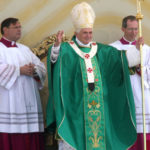
On April 19, 2005, Cardinal Joseph Ratzinger emerged on the balcony of St. Peter’s Basilica and was introduced to the world as the new Roman pontiff, taking the name Pope Benedict XVI. The conclave of 115 cardinals in the Sistine Chapel acted with unexpected speed – just 24 hours – to choose one of their number as the successor to Pope John Paul II. The choice of Ratzinger, a German cardinal who earned a reputation for controversy in nearly 24 years as the Vatican’s doctrinal watchdog, was an even bigger surprise than the speed of the vote.
A year later, there was enormous interest in what sort of pope he was proving to be.
Was he a papal “hard-liner” the way many believe he was as a cardinal? What changes had he made, and what changes could be expected? How were his decisions being received by his flock? How did he differ from his predecessor, and how was he the same? And how were the papacy and the church faring after the death of John Paul, a hugely popular figure whose cause for canonization Benedict himself put on the fast track?
Why it matters
As the spiritual leader of more than 1 billion Catholics worldwide, and about 70 million in the United States, the pope can have enormous influence on the religious, ethical and political choices of a large percentage of the population. His reign is watched with particular interest in America, where scandals have left the Catholic Church – the nation’s largest denomination – in turmoil in recent years. Moreover, the pope is considered an important global statesman who regularly receives other world leaders. He also makes his views known through his delegates to the United Nations, where the Holy See has a high-profile diplomatic mission.
Background
New cardinals
The selection of cardinals is one of the most closely watched developments in a pontificate because it is those men who will choose a pope’s successor from their own number. In February 2006, Benedict announced that he would create 15 new cardinals, 12 of them under the age of 80 and thus eligible to vote in a conclave. Benedict officially appointed the new cardinals at a Vatican ceremony called a “consistory” on March 24. John Paul routinely created dozens of cardinals at a time, often surpassing the limit of 120 electors (that is, cardinals under 80 years old). By appointing a smaller number, Benedict indicated he would respect the 120-elector ceiling and create fewer cardinals, though perhaps more frequently. Benedict also surprised some Vatican watchers by naming more Europeans than African or Latin American cardinals, apparently halting a trend.
-
“The Truce of 2005?”
Article by the Rev. Richard John Neuhaus about American dissent to official Vatican positions on sexuality as well as criticism of some of Pope Benedict’s early appointments of bishops including promoting the archbishop of San Francisco, William Levada, to succeed himself at the Congregation for the Doctrine of the Faith as the church’s doctrinal gatekeeper and the appointment of Salt Lake City Bishop George Niederauer to succeed Levada in San Francisco, both of whom are seen as liberal on matters of sexuality.
-
The Cardinals of the Holy Roman Church
Exhaustive catalog of information on cardinals past and present with biographies, geographic distribution and a wealth of other information. Compiled by Salvador Miranda, a retired professor of library sciences at Florida International University.
-
The Hierarchy of the Catholic Church
Current and historical information about the bishops and dioceses of the Catholic Church.
Curia downsizing
Benedict was long expected to act on recommendations to reorganize and perhaps reduce the Roman Curia, the church’s central bureaucracy. Many observers were surprised that he did not act more quickly, but in March 2006 he began to take steps to downsize and consolidate certain offices. Observers expected that process to continue into the future.
-
“Reorganization begins in Roman Curia”
Catholic World News article about Pope Benedict’s decision to consolidate the leadership of four Vatican councils under two presidents, one of his first reforms of the Curia.
The Encyclical
-
Deus Caritas Est (God is Love)
Pope Benedict’s first encyclical. An encyclical is considered one of the most authoritative documents from the pen of the pope, and a new pontiff’s first encyclical is considered something of a “mission statement” for the rest of the pontificate. Benedict’s first, Deus Caritas Est, or God is Love, was considered surprising by some in that it did not deal with the controversial moral issues Ratzinger was known for, but with the concept and application of Christian charity and the relation to divine and sexual love, agape and eros. Still, some saw in the document hints of a change in focus from traditional Catholic social justice teachings – a change that reflects Benedict’s longtime views.
Homosexuals and the priesthood
An initiative to keep homosexuals out of the priesthood had been debated for years in the Vatican, at the initiative of then-Cardinal Ratzinger. But the policy was never implemented until Ratzinger became Pope Benedict. In November 2005, the Vatican issued a document under Benedict’s signature, titled “Concerning the Criteria for the Discernment of Vocations with Regard to Persons with Homosexual Tendencies in View of Their Admission to the Seminary and to Holy Orders.” The document’s aim was to bar gay men from the priesthood, and it caused wide debate. At the same time, the Vatican began an inspection of U.S. seminaries in an effort to tighten up on the preparation of future priests in the wake of the clergy sex abuse scandals, including their ability to deal with celibacy. That initiative also sparked some controversy.
-
“On priesthood and those with homosexual tendencies”
Full text of the Vatican instruction entitled, “Concerning the Criteria for the Discernment of Vocations with Regard to Persons with Homosexual Tendencies in View of Their Admission to the Seminary and to Holy Orders.” The document’s aim is to bar gay men from the priesthood.
Synod
A Synod of Bishops is a nearly monthlong meeting of several hundred of the world’s bishops at the Vatican under the direction of the pope. It is usually held every three years, and Benedict presided over the October 2005 synod, which was scheduled long before he was elected. The theme was the Eucharist, but the synod entailed discussions of many difficult issues, such as whether divorced-and-remarried Catholics can take communion. The synod’s conclusions held the line on existing policies while recognizing the debates. The Vatican web site has a list of the relevant documents and Benedict’s addresses.
World Youth Day
Benedict was not expected to travel nearly as much or as widely as his peripatetic predecessor, but observers said his visits would have an impact and would each convey an important message. Benedict’s first trip outside Italy was an event he inherited from John Paul, World Youth Day (Aug. 18-21, 2005) in Cologne, but one he made very much his own in large part because it had been scheduled for Germany, his homeland. The trip was seen as a success, though it also signaled how Benedict would differ in style from the charismatic John Paul. Moreover, the visit was important because Benedict met with leaders of other Christian churches and the Jewish and Muslim communities. His speeches gave indications of his approach to ecumenical and interfaith dialogue. The Vatican website has a list of all the World Youth Day talks.
The "America" affair
Almost immediately after Benedict’s election, the Rev. Thomas Reese resigned as editor of the weekly magazine America, the flagship Jesuit periodical that he had led for years. Although Reese did not comment on the reasons, it emerged that Benedict, in one of his last acts before the conclave that elected him pope, pressured the Society of Jesus to remove Reese. Apparently Ratzinger did not like some of the issues America was covering. When Ratzinger was elected pope, Reese’s departure, which the Jesuits resisted, became a foregone conclusion. The controversy over Reese’s departure, however, drew wide public interest and threatened to cast a shadow over the start of Benedict’s pontificate. Read the National Catholic Reporter article about Reese’s departure.
Books and biographies
-
“The Rise of Benedict XVI: The Inside Story of How the Pope Was Elected and Where He Will Take the Catholic Church”
Written by John L. Allen Jr. (Doubleday, 2005). Looks at the behind-the-scenes dynamics within the College of Cardinals that led to the choice of Joseph Ratzinger as Pope Benedict XVI, and where the new pope is likely to lead the Catholic Church.
-
“Pope Benedict XVI: A Biography of Joseph Ratzinger”
Reissue (Continuum, 2005) of John L. Allen’s 2000 biography of Ratzinger subtitled, The Vatican’s Enforcer of Faith. Allen later said he thought that book was too harsh on Ratzinger.
-
“God’s Choice: Pope Benedict XVI and the Future of the Catholic Church”
Written by George Weigel (HarperCollins, 2005). Chronicle of the rise of Pope Benedict XVI as well as an unflinching view of the Catholic Church at the dawn of a new era.
-
“The Making of the Pope 2005”
Written by the Rev. Andrew M. Greeley (Little, Brown, 2005). This is an update from Greeley’s 1978 classic about the previous conclave.
-
“A Church in Search of Itself: Benedict XVI and the Battle for the Future”
Written by Robert Blair Kaiser (Knopf, 2006). Kaiser examines some of the most important and divisive issues confronting the Church: the sex abuse scandal, a shortage of priests due to the insistence upon celibacy, the ban on contraception, the roles of women in the Church, and the increased participation of laypeople in Church affairs while giving an in-depth and behind-the-scenes view of six of the cardinals who gathered in Rome in April 2005 to choose the new pope.
-
“Holy Father: Pope Benedict XVI: Pontiff for a New Era”
Written by Greg Tobin (Sterling, 2005). Offers a first look at the much-anticipated new leader of the Catholic Church and examines what lies ahead for the Catholic Church and its people.
-
“Pope Benedict XVI: Successor to Peter”
Written by the Rev. Michael Collins (Paulist Press, 2005). Collins describes the former Cardinal Ratzinger in both a human and historical context starting with the Pope’s early years in Bavaria and his youth during the Second World War.
-
“We Have a Pope! Benedict XVI”
Written by Matthew E. Bunson (Our Sunday Visitor, 2005). Bunson provides a detailed portrait of Benedict XVI, introducing Catholics to a man of powerful intellect and confident faith who now must lead the Church as it confronts some of the most challenging issues facing modern men and women.
-
“Pope Benedict XVI: A Personal Portrait”
Written by Heinz-Joachim Fischer (Crossroad, 2005). Fischer, Rome correspondent for a leading German newspaper, focuses on Benedict’s career as a cardinal and head of the Congregation for the Doctrine of the Faith. Fischer has known Ratzinger since 1976.
-
“The Thought of Pope Benedict XVI: An Introduction to the Theology of Joseph Ratzinger”
Written by the Rev. Aidan Nichols (Burns & Oates, 2005). Nichols presents a full-scale investigation of Joseph Ratzinger’s theology, from the 1950s to the present day in this update of Nichols’ original book on Ratzinger’s theology written in the 1980s.
-
“Pope Benedict XVI: His Life and Mission”
Written by Stephen Mansfield (Tarcher, 2005). Mansfield analyzes Pope Benedict’s life including his transition from a liberal theologian associated with Vatican II to a theological conservative who became Pope John Paul’s closest ally.
-
“Benedict XVI: The Man Who Was Ratzinger”
Written by Michael S. Rose (Spence Publishing, 2005). Rose examines the areas where Pope Benedict may break with his predecessor Pope John Paul II.
-
Ignatius Press
Ignatius Press, located in San Francisco, is the official publisher of all Benedict’s works in English, including all those he wrote as a priest and cardinal. The CEO of Ignatius Press is Mark Brumley.
National and international sources
-
John L. Allen Jr.
John L. Allen Jr. is editor of Crux, a website specializing in coverage of the Catholic Church. He previously was the longtime Rome correspondent for National Catholic Reporter. Allen is considered a top Vaticanologist and a leading English-language expert and commentator on the papacy.
-
Joseph A. Komonchak
The Rev. Joseph A. Komonchak holds the John and Gertrude Hubbard Chair in Religious Studies at the Catholic University of America in Washington, D.C. Komonchak has written frequently about Pope Benedict XVI’s thought and theology, and his June 3, 2005, article, “The Church in Crisis: Pope Benedict’s Theological Vision,” in Commonweal magazine was recognized for its insight.
-
Jeannine Gramick
Sister Jeannine Gramick was ordered to stop ministering to homosexuals by then-Cardinal Ratzinger in 1999. She has defied Vatican orders to cease her ministry to gay and lesbian Catholics. Contact her through the organization she co-founded, New Ways Ministry, in Mount Rainier, Md.
-
Thomas Reese
The Rev. Thomas J. Reese is a Jesuit priest and senior analyst for Religion News Service. He writes and comments widely on Catholic culture and politics. He is the author of Inside the Vatican: The Politics and Organization of the Catholic Church.
-
Christopher Bellitto
Christopher Bellitto is chair of the history department at Kean University in New Jersey, where he has taught a course on the papacy. He has also written many articles on Catholicism and is a regular television commentator on Vatican stories.
-
Mary Ann Glendon
Mary Ann Glendon is the Learned Hand Professor at Harvard Law School and was a vocal advocate of Pope John Paul II’s views on women, abortion, sexuality and related issues. In 2004 the pope appointed her as head of the Vatican’s Pontifical Academy of Social Sciences, at that time the highest Vatican post ever held by a woman. From 2008 to 2009 she was the U.S. ambassador to the Holy See.
-
Robert P. Imbelli
The Rev. Robert P. Imbelli is an associate professor emeritus of theology at Boston College and has written and commented widely on the theology and policies of Pope John Paul II and Pope Benedict XVI.
-
George Weigel
George Weigel is an orthodox-minded Catholic theologian and distinguished senior fellow at the Ethics and Public Policy Center in Washington, D.C. He is the author of God’s Choice: Pope Benedict XVI and the Future of the Catholic Church (2005) and Witness to Hope (1999), which is essentially the authorized biography of Pope John Paul’s papacy. Weigel also wrote The End and the Beginning: Pope John Paul II : The Victory of Freedom, the Last Years, the Legacy (2010).
-
Joseph Fessio
The Rev. Joseph Fessio is a close friend and former theology student of Cardinal Joseph Ratzinger, Pope Emeritus Benedict XVI. Fessio is widely considered one of the most influential conservative voices in the American church, and he is an outspoken opponent of allowing gay men into the priesthood. Fessio is the editor-in-chief of Ignatius Press in San Francisco, which was the English-language publisher for Benedict’s books. Fessio spends much of his time in Naples, Fla. Contact through Rose Trabbic, media representative for Ignatius Press.
-
Helen M. Alvaré
Helen M. Alvaré is a professor of law at George Mason University in Virginia. Alvaré chaired the commission investigating clerical abuse in the Archdiocese of Philadelphia and was an adviser to Pope Benedict XVI’s Pontifical Council for the Laity, as well as an ABC News consultant. Her scholarship regularly addresses current controversies about marriage, parenting and the new reproductive technologies.
-
John T. Ford
The Rev. John T. Ford is a professor at the school of theology and religious studies at the Catholic University of America in Washington, D.C.. He has often used Pope Benedict XVI’s books as texts in his courses on Christianity.
-
The Vatican
The official website of the Holy See.
Regional sources
In the Northeast
-
Stephen Pope
Stephen Pope is a professor of theology at Boston College and a frequent commentator on church affairs and the papacy. He is author of The Evolution of Altruism and the Ordering of Love and writes about different forms of love in Christian thought, Christian ethics, justice, and charity, and evolutionary theory.
-
Alice Laffey
Alice Laffey is an associate professor of religious studies at College of the Holy Cross in Worcester, Mass. She has written a history of papal statements and the evolution of papal teaching, and she can address issues regarding women and gender.
-
Lisa Sowle Cahill
Lisa Sowle Cahill is a professor of theology at Boston College who has written about genetics from a Christian perspective. Her books include Theological Bioethics: Participation, Justice and Change and Bioethics and the Common Good.
-
Robert Wister
The Rev. Robert Wister is a leading expert on the history of the papacy. He is a professor of church history at Seton Hall University in New Jersey. He earned a doctorate in church history at the Gregorian University in Rome.
-
John S. Grabowski
John S. Grabowski is an associate professor of religious studies at the Catholic University of America in Washington, D.C. He also has an expertise in women’s issues. He and his wife were appointed to the Pontifical Council for the Family by Pope Benedict XVI in the fall of 2009.
-
Rocco Palmo
Rocco Palmo runs the blog Whispers in the Loggia, one of the most popular sites in the Catholic blogosphere. He is a frequently quoted expert on Vatican developments and was formerly a Philadelphia-based U.S. correspondent for The Tablet of London.
-
Stephen D. Miles
Stephen D. Miles is associate professor of theology at Immaculata University in Pennsylvania. His teaching and research interests include the Catholic Church and the pope.
In the South
-
Gerald P. Fogarty
The Rev. Gerald P. Fogarty is a professor of religious studies and history at the University of Virginia and an expert on the Vatican. He is the author of several books on Catholicism and the papacy. His essay “The Papacy: From Low Regard to High Esteem” is part of a 2000 collection from Liturgical Press titled The Catholic Church in the Twentieth Century.
-
Peter J. Bernardi
The Rev. Peter J. Bernardi is an associate professor of religious studies at Loyola University in Chicago. He can talk about the papacy in the contemporary world. He contributed an essay to the collection in Catholicism Contending With Modernity: Roman Catholic Modernism and Anti-Modernism in Historical Context.
-
William F. Maestri
The Rev. William F. Maestri is a theologian and spokesman for the Archdiocese of New Orleans with a specialty in bioethics. He can talk about Pope John Paul II’s philosophical defense of human dignity in all contexts — medical, economic, etc.
-
Charles E. Curran
Charles E. Curran is the Scurlock Professor of Human Values at Southern Methodist University in Dallas. He specializes in moral theology, social ethics and the role of the church as a moral and political actor in society. He is a liberal theologian who was dismissed from Catholic University of America for his teachings on human sexuality after an extended struggle, which included meetings with then-Cardinal Joseph Ratzinger. Curran can also comment on the politics of the papacy.
In the Midwest
-
Dennis Doyle
Dennis Doyle is a professor of religious studies at the University of Dayton and a frequent commentator and author on Catholic issues and the papacy.
-
Steven M. Avella
The Rev. Steven M. Avella is associate professor of history at Marquette University in Milwaukee and an expert on American Catholic history and the history of the American West.
-
Christopher Ruddy
Christopher Ruddy is an associate professor of historical and systematic theology at the Catholic University of America in Washington, D.C. He wrote about the theology of Pope Benedict in a June 3, 2005, Commonweal magazine article titled “No Restorationist.”
In the West
-
Thomas P. Rausch
The Rev. Thomas P. Rausch is a professor of theology at Loyola Marymount University in Los Angeles. A Catholic priest, Rausch is the author of Authority and Leadership in the Church: Past Directions and Future Possibilities.
-
James Eblen
The Rev. James Eblen is a professor emeritus in Seattle University’s school of theology and ministry who can speak about the papacy.