


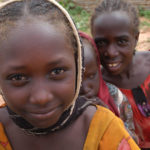
The United States called it genocide, and the United Nations called it one of the world’s worst humanitarian crises. The murderous conflict in Darfur, in western Sudan, deepened as the government and rebels stepped up attacks on each other. A stunningly diverse range of individuals and organizations pushed for the United States – and the world – to put a stop to it. Religion and ethics were key to most aspects of the story.
Why it matters
All religions encourage helping the powerless and oppressed. If Catholics, Protestants, Jews, Muslims, Buddhists and others press for action, can they help resolve humanitarian crises?
Background
- Darfur attracted one of the largest, broadest and deepest coalitions of faith groups ever to agree on the urgency of a crisis and the need to lobby persistently for action to address it. They organized rallies and public education campaigns, pressured government officials, prayed, and joined forces with secular groups.
- The problems in Sudan and Darfur include religion but are inextricably bound up with ethnicity, race and abuse of government power, as religious conflicts throughout the world tend to be. Sudan endured a two-decade civil war between the Arab Muslim north and the south, where mostly black Africans who practice Christianity or animism live. Violence escalated in Darfur in 2003 when rebels increased attacks and the Sudanese government sent militias to stop them.
- Morality was the central topic in the debate over how the United States should address problems in Darfur. For many, morality stems from religious faith. At a time when Americans say they are concerned with morals and values, the debate over Darfur presented a prime example of how moral issues are debated and acted upon in the public square. How does a country decide what can and should be done?
- Darfur highlighted that genocide is a real threat in the world. Some of the earliest advocates of intervention in Darfur were Jewish individuals and organizations who say they feel a moral obligation to stop other genocides after the experience of the Holocaust. Journalists will find that since the Holocaust, dozens of research centers, human rights organizations, academics and activists have acquired considerable expertise on genocide.
- While some feel powerless when they hear of an international crisis, Darfur inspired many ordinary individuals to take extraordinary actions. Consider Eric Reeves, an English professor whose lunch with a Doctors Without Borders member led to a writing and advocacy campaign that catapulted him – and Darfur – into national news stories. Darfur inspired a good deal of student activism. A group of Swarthmore College students’ long nights of sending emails out to raise money for Darfur inspired the United to End Genocide coalition, which includes campus groups across the nation. Wherever they live, journalists can find other compelling stories of people who decided to take action or raise their voice.
- Darfur raised the specter of evil. The government of Sudan turned away help and advice, blocked international efforts to stem the killing and continued what it called an anti-insurgent effort, which resulted in the murder of thousands of people. How do people respond when they sense they are dealing with evil?
- Victims in Darfur suffered unimaginable traumas, including torture and rape. The relatives and survivors of victims of other genocides – in Rwanda, Armenia and the Holocaust – were among the loudest advocating for action. Torture has been in the news because of abuses during the Iraq war, and religious groups are at the forefront of pressing for an end to torture and helping with recovery.
- Darfur was debated internationally (through the United Nations), nationally (in Congress and with President Bush), in states (through state legislatures) and locally (through rallies and awareness-raising events).
Resources
- The New York Times posts its archive of stories on Sudan. It also archives columns by Nicholas D. Kristof, who won a 2006 Pulitzer Prize for commentary, which included his columns on Darfur.
- Save Darfur’s website lets you search for local groups throughout the nation.
- The BBC posts a timeline of events in Sudan from the 1800s to the present day.
- Read the United Nations Convention on the Prevention and Punishment of the Crime of Genocide, adopted in 1948.
- The Institute for the Study of Genocide has a page linking to organizations that research genocide.
National sources
Advocacy
-
The Save Darfur Coalition
The Save Darfur Coalition is an alliance of more than 170 faith, advocacy and humanitarian organizations, representing all the major religions and dozens of Jewish, Muslim and Christian groups. It advocates for public awareness and public policy change and provides aid. It is now part of the United to End Genocide coalition.
-
United to End Genocide
United to End Genocide began as the Genocide Intervention Network at Swarthmore College in 2005 as a way to raise money to help resolve the Darfur crisis. It has developed into a network of campus groups across the country. It is now based in Washington, D.C.
-
Genocide Watch
Gregory Stanton is president of Genocide Watch, a Washington, D.C., organization that “exists to predict, prevent, stop, and punish genocide and other forms of mass murder,” including in Sudan. Its board of advisers includes academics from around the country.
-
Avaaz
Ricken Patel is founding President and Executive Director of Avaaz, “a global web movement to bring people-powered politics to decision-making everywhere.” Avaaz has more than 20 million subscribers and activists.
-
Human Rights Watch
Human Rights Watch is an independent, nongovernmental organization dedicated to protecting human rights worldwide. Contact HRW via one of its local offices.
-
John C. Danforth
John C. Danforth, an Episcopal priest and a former U.S. senator, has served as special envoy to Sudan under President Bush and also as U.S. ambassador to the United Nations from 2004-2005.
-
The United States Holocaust Memorial Museum
The United States Holocaust Memorial Museum in Washington, D.C., commemorates those who died in the Holocaust and strives to confront bigotry and genocide throughout the world today.
The museum posts a “genocide emergency” page on Sudan.
Academic
-
Francis Mading Deng
Francis Mading Deng is South Sudan’s first ambassador to the United Nations. From 1992 to 2004, he was the representative of the U.N. Secretary-General on Internally Displaced Persons and from 2007 to 2012 he was the UN Special Adviser for the Prevention of Genocide. He is author of more than 20 books, including War of Visions: Conflicts of Identities in the Sudan (Brookings Institution Press, 1995). Deng is a nonresident senior fellow at the Brookings Institution. Contact him via the Brookings website.
-
Jok Madut Jok
Jok Madut Jok is Executive Director of the Sudd Institute. Jok joined the Government of South Sudan as undersecretary in the Ministry of Culture and Heritage. He was an associate history professor at Loyola Marymount University in Los Angeles and author of Sudan: Race, Religion and Violence (OneWorld Publications, 2007) and War and Slavery in Sudan (The Ethnography of Political Violence) (University of Pennsylvania Press, 2001).
-
Mahmood Mamdani
Mahmood Mamdani is an anthropology and government professor at Columbia University in New York and author of When Victims Become Killers: Colonialism, Nativism and the Genocide in Rwanda (Princeton University Press, 2002.). He has also researched Sudan.
-
Walid Phares
Walid Phares is a Middle East scholar and expert on global terrorism and persecuted minorities. He was a senior fellow at the Foundation for the Defense of Democracies. He is an analyst at Wikistrat and a frequent media commentator.
-
Samantha Power
Samantha Power is Former Special Assistant to the President and Senior Director for Multilateral Affairs and Human Rights at the National Security Council. She was a professor of Global Leadership and Public Policy at Harvard University’s John F. Kennedy School of Government. She wrote A Problem From Hell: America and the Age of Genocide (Basic Books, 2002), which won the 2003 Pulitzer Prize for general nonfiction, the 2003 National Book Critics Circle Award for general nonfiction and the Council on Foreign Relations’ Arthur Ross Prize for the best book in U.S. foreign policy. Power’s New Yorker article on Darfur won the 2005 National Magazine Award for best reporting.
-
Samuel Totten
Samuel Totten is professor emeritus of education at the University of Arkansas’ College of Education and Health Professions. He is co-editor of Genocide in Darfur (Routledge, 2006), editor of Genocide at the Millennium (Transaction Publishers, 2005) and author of Teaching About Genocide (Information Age, 2004). He was a member of the Council of the Institute on the Holocaust and Genocide (Jerusalem) and the Centre for Genocide Studies (Sydney, New South Wales, Australia) and co-chief editor of the journal Genocide Studies and Prevention.
-
Alex de Waal
Alex de Waal is Executive Director of the World Peace Foundation and a Research Professor at the Fletcher School at Tufts University in Somerville, Mass. He was a fellow of the Global Equity Initiative at Harvard University in Cambridge, Mass. He studies the social, political and health dimensions of war, famine and genocide. He is the author of Famine That Kills: Darfur, Sudan, 1984-1985 (Oxford University Press, 1989) and Facing Genocide: The Nuba of Sudan (African Rights, 1995) and editor of Islamism and Its Enemies in the Horn of Africa (Indiana University Press, 2004).
-
Morton Abramowitz
Morton Abramowitz is a senior fellow at the Century Foundation, a former president of the Carnegie Endowment for International Peace and a former employee of the U.S. State Department.
Religious
-
Thomas G. Wenski
Archbishop Thomas G. Wenski of Miami, Fla., has headed the U.S. Catholic Bishops’ International Policy Committee, which pressed for more action to stop the killings in Darfur.
-
Evangelicals for Darfur
Evangelicals for Darfur was a campaign by 20 prominent progressive and conservative evangelical leaders to bring an end to the killing in Darfur. It was organized by Sojourners/Call to Renewal, led by the Rev. Jim Wallis, in partnership with the Save Darfur Coalition. Contact Tim King, Chief Communications Officer.
-
World Vision
World Vision is a Christian relief and development agency working on poverty reduction worldwide. World Vision president Richard Stearns’ book The Hole in Our Gospel won the 2010 Christian Book of the Year award. One focus of its work is sustainable development, including microfinance — it opened a microlending website this spring and has already attracted $385,000 and made more than 1,250 loans — and women’s and girls’ issues.
-
The National Council of Churches USA: Darfur
The National Council of Churches USA, representing mainline Protestant, Orthodox, African-American and peace churches, posted resources about its advocacy for Darfur.
-
The Africa Faith and Justice Network
The Africa Faith and Justice Network advocates for responsible U.S. relations with Africa from a Catholic perspective.
-
Islamic Relief Worldwide
Islamic Relief Worldwide, based in Birmingham, U.K., provided aid to Darfur. Its U.S. branch is based in Buena Vista, California.
-
American Jewish World Service
American Jewish World Service “works to realize human rights and end poverty in the developing world.” AJWS founded the Save Darfur Coalition, an alliance of more than 170 faith-based, advocacy and humanitarian organizations.
The nation’s major Jewish organizations all support the Save Darfur Coalition, including Jewish Council for Public Affairs, American Jewish Committee, Anti-Defamation League, Central Conference of American Rabbis, Conference of Presidents of Major Jewish Organizations and others.
Regional sources
In the Northeast
-
Eric Reeves
Eric Reeves, an English professor at Smith College in Northampton, Mass., has a website recording his years of advocacy and analysis of the events in Sudan. He is a frequent op-ed writer and commentator on the subject.
-
Omer Bartov
Omer Bartov, Brown University professor of European history, is the author of The “Jew” in Cinema: From the Golem to Don’t Touch My Holocaust (Indiana University Press, 2005). The book looks at how stereotypical portrayals of the “Jew” have informed European, American and Israeli cinema since the 1920s. In fall 2005, 200 students took his class, Modern Genocide and Other Crimes Against Humanity.
-
Ronan Farrow
Ronan Farrow is a human rights activist, journalist, lawyer and government official. He was a UNICEF Spokesperson for Youth who worked to end the killing in Darfur.
-
Stephanie Nyombayire
Stephanie Nyombayire is a representative for the Genocide Intervention Network and a Rwandan native. She worked at Swarthmore College in Pennsylvania to end the crisis in Darfur. Dozens of her family members died in the Rwandan genocide of 1994. Contact through United to End Genocide.
-
Michael N. Dobkowski
Michael N. Dobkowski is professor of religious studies at Hobart and William Smith Colleges in Geneva, N.Y., and co-editor of The Coming Age of Scarcity: Preventing Mass Death and Genocide in the 21st Century (Syracuse University Press, 1998).
-
Timothy Longman
Timothy Longman is director of the African Studies Centre at Boston University and author of Commanded by the Devil: Christianity and Genocide in Rwanda (Cambridge University Press).
-
Randolph L. Braham
Randolph L. Braham is director of the Rosenthal Institute for Holocaust Studies at the City University of New York. He is author of The Politics of Genocide: The Holocaust in Hungary (Wayne State University Press, 2000) and The Vatican and the Holocaust (East European Monographs, 2000).
-
Debórah Dwork
Debórah Dwork is a senior research scholar with the Strassler Family Center for Holocaust and Genocide Studies at Clark University in Worcester, Mass. She is an expert on Holocaust history and education.
-
James E. Waller
James E. Waller is the Cohen Chair of Holocaust and Genocide Studies at Keene State College in New Hampshire and author of Becoming Evil: How Ordinary People Commit Genocide and Mass Killing (Oxford University Press, 2002).
In the South
-
Helmut Walser Smith
Helmut Walser Smith is Martha Rivers Ingram Chair of History at Vanderbilt University and Director of the Max Kade Center for European and German. He is author of The Holocaust and Other Genocides: History, Representation, Ethics (Vanderbilt University Press, 2002).
-
Alan Kuperman
Alan Kuperman is associate professor of public affairs at the University of Texas at Austin. He is author of The Limits of Humanitarian Intervention: Genocide in Rwanda (Brookings Institution Press, 2001) and co-editor of Gambling on Humanitarian Intervention: Moral Hazard, Rebellion, and Civil War (Routledge, 2006).
In the Midwest
-
Robert Melson
Robert Melson is political professor at Purdue University in West Lafayette, Ind., and current president of the International Association of Genocide Scholars, which he co-founded in 1995. His primary area of research is ethnic conflict and genocide, and he has written widely on the topic.
-
Peter J. Haas
Rabbi Peter J. Haas is a Jewish studies professor and director of the Rosenthal Center for Judaic Studies at Case Western Reserve University in Cleveland. He wrote Human Rights and the World’s Major Religions: The Jewish Tradition (Greenwood Press, 2005).
-
Michael A. Sells
Michael A. Sells is professor of Islamic history and literature at the University of Chicago. He has written on genocide in Bosnia in the context of Islamic belief.
-
Eric D. Weitz
Eric D. Weitz is a history professor at the University of Minnesota in Minneapolis-St. Paul and author of A Century of Genocide: Utopias of Race and Nation (Princeton University Press, 2005).
-
Lawrence J. LeBlanc
Lawrence J. LeBlanc is professor of political science at Marquette University in Milwaukee and author of The United States and the Genocide Convention (Duke University Press, 1991). He specializes in international politics, international law and organizations, and U.S. foreign policy.
-
Bettina Arnold
Bettina Arnold is associate professor of anthropology at the University of Wisconsin-Milwaukee and author of “Justifying Genocide: The Supporting Role of Archaeology in ‘Ethnic Cleansing’” for the book Annihilating Difference: The Anthropology of Genocide (University of California Press, 2002).
in the West
-
George E. Tinker
George E. Tinker is professor of American Indian cultures and religious traditions at Iliff School of Theology in Denver. His books include, as author, Missionary Conquest: The Gospel and Native American Cultural Genocide (Fortress Press, 1993) and Spirit and Resistance: Political Theology and American Indian Liberation (Fortress Press, 2004); as co-author, A Native American Theology (Orbis Books, 2001); and, as co-editor, Native Voices: American Indian Identity and Resistance (University Press of Kansas, 2003).
-
James E. Waller
James E. Waller is the Cohen Chair of Holocaust and Genocide Studies at Keene State College in New Hampshire and author of Becoming Evil: How Ordinary People Commit Genocide and Mass Killing (Oxford University Press, 2002).
-
Eliz Sanasarian
Eliz Sanasarian is political science professor at the University of Southern California at Los Angeles and has written on gender distinction in genocide in the context of Armenia.
-
Marvin Hier
Rabbi Marvin Hier is the dean and founder of the Simon Wiesenthal Center in Los Angeles, one of the foremost advocates for Jewish causes and opponents of anti-Semitism.