


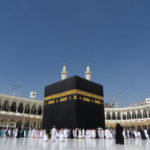
As the world worried about a possible influenza pandemic in late 2006, Muslim health experts warned that the huge gathering for the hajj posed the risk of rapid international spread of infection. They called for mandatory flu shots for all pilgrims.
More than 2 million people from all over the world converged on Saudi Arabia beginning Dec. 29, 2006, for the one of the largest gatherings on earth — the five days of the Muslim pilgrimage of hajj. Hajj is one of the five pillars of Islam, which has more than 1.3 billion followers around the world. All Muslims are required to make a pilgrimage to Mecca at least once in their lifetime if they are physically and financially able to do so.
Health experts, concerned that a global influenza pandemic was overdue, said such a huge gathering of international travelers posed special risks. Pilgrims are packed tightly together for the five days during which religious rituals are performed; so tightly that there have been cases of people being trampled to death. The contagion risk posed by so vast an international assembly “can no longer be ignored,” a group of Muslim health experts in Saudi Arabia and Britain wrote in an editorial published in the Dec. 9, 2006, issue of the British Medical Journal.
Background
Because the rituals of hajj must be performed at a specific time of the Muslim calendar and in a specific place, pilgrims find themselves in huge crowds and crowded accommodations — conditions conducive to the “rampant spread of the influenza virus and a global pandemic,” the editorial warned. The world had “inadequately prepared” for the “devastating prospect,” the authors added.
Of course, the danger of an international epidemic was even greater in the days before antibiotics, vaccines and modern public health practices. Almost half of those on the 1831 hajj, for example, contracted cholera from contaminated water. Heading homeward, they spread the disease into Turkey and the Middle East, across North Africa, through the Balkans, and, via the Danube, as far as Hungary. Today measures such as mandatory vaccination against polio and meningitis help safeguard the health of the pilgrims as well as those back home.
The percentage of pilgrims getting influenza shots, which are recommended but not required, is “worryingly” low, according to a letter published in the British Medical Journal. Although Saudi Arabia’s Ministry of Health advises pilgrims to wear face masks to reduce the spread of germs, many of the faithful see this as violating the requirement that male pilgrims refrain from covering their heads. The World Health Organization and Saudi health authorities should adopt a “coherent international response” as part of the worldwide strategy “to prevent a possible influenza pandemic,” the editorial urged.
Why it matters
The flu warning raised a complicated question that reporters can explore in their local communities:
- How much should be done to make sacred religious rituals safe for public health?
- Whose responsibility is it to raise such a question?
- Whose responsibility is it to see that precautions be taken?
Articles
-
“Hajj Requirements”
Read a Royal Embassy of Saudi Arabia page about Hajj requirements, the fifth pilar of Islam.
-
“Swine flu pushes authorities to warn pilgrims to be prudent about pilgrimage to Makkah”
Read a July 23, 2009 article about the warning sent out by health officials concerning Hajj and the swine flu epidemic.
-
“Hajj pilgrims need flu shots, docs”
See a Dec. 7, 2006, UPI story about the flu warning.
-
“When on Hajj, Wear a Facemask”
Read an April 23, 2006, Seed magazine article about health on the hajj.
Sources
-
Shiraz A. Malik
Shiraz A. Malik is executive director of the Islamic Medical Association of North America in Lombard, Ill.
-
Aziz Sheikh
Aziz Sheikh is professor of primary care research and development at the University of Edinburgh, Scotland, and a co-author of the editorial, “Hajj and the Risk of Influenza,” published Dec. 9, 2006, in the British Medical Journal.
-
Shuja Shafi
Shuja Shafi, a microbiologist at Northwick Park Hospital in Harrow, United Kingdom, is a co-author of the editorial, “Hajj and the Risk of Influenza,” and the letter, “Influenza Vaccine Uptake among British Muslims Attending Hajj, 2005 and 2006,” published in the British Medical Journal, Dec. 9, 2006.