


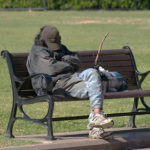
People who work with the homeless say they’re seeing more families, more women and children, and more people who were knocked down by a job loss, divorce or domestic violence – or by jobs that paid too little and medical bills or housing that cost too much. They are also seeing more people who have jobs that pay minimum wage or less and can’t afford housing.
Shelters are teeming with veterans and teenagers, people struggling with mental illness and substance abuse, people who have been homeless for years, and new arrivals who never imagined they would be homeless.
The factors contributing to homelessness are complicated, but so is the public response to it. Some cities, fed up by complaints about panhandling and loitering, are passing ordinances that restrict where charitable groups can feed and aid the homeless. Some, disturbed by violent attacks on the homeless, are trying to add protections to hate-crime legislation.
Religious groups are a primary source of food and shelter for homeless people. But now more religious groups are turning their attention to public advocacy on root causes of homelessness – issues such as access to affordable housing and mental health services. In other words, rather than working to “catch the falling families,” as one researcher put it, they’re pushing lawmakers to change policies so people are less likely to fall.
Background
Why it matters
Most religious traditions teach the importance of caring for the least and the lost. The suffering of men, women and children who have no place to live presents significant questions of public policy – for the schools that must educate homeless children, for the military, for health care institutions, for determining what’s fair in setting wages and housing policy, and much more.
Angles for reporters
- Many advocates for the homeless say the population is changing. They’re seeing more women and children, and sometimes teenagers on their own. How are service providers – and public policy efforts – responding to this changing population?
- Some people of faith are getting involved not just in providing direct services – giving food and warm clothing to the homeless, offering shelter – but also in public policy advocacy, trying to influence legislation involving affordable housing and the payment of a living wage, for example. The Greater Cincinnati Coalition for the Homeless is helping day laborers trying to improve working conditions and wages.
- Some faith communities are making outreach to the homeless a direct part of their ministry – look around for examples of creativity.
- Some homeless people refuse to stay in shelters because they consider them unclean, unsafe, too crowded or too restrictive. Find out what conditions are like in your community. And sometimes congregations get involved in trying to minister to those outside the shelter system – cruising known sleeping spots with warm blankets, for example, when the weather gets particularly frigid.
- Talk to local librarians. In many cities, homeless people pack the libraries each morning after shelters close their doors.
- Find out how shelters are dealing with concerns about sexual orientation. Some studies estimate that as many as one in five homeless youth may be gay or lesbian, and some teenagers leave home because of conflicts over their sexuality.
Federal legislation
-
Homeless Emergency Assistance and Rapid Transition to Housing (HEARTH) Act
The Homeless Emergency Assistance and Rapid Transition to Housing (HEARTH) Act of 2009 is the most recent re-authorization of the McKinney-Vento Homeless Assistance Act of 1987, the first and only federal law aimed directly at combating homelessness.
State and local legislation
- Some U.S. cities, including Dallas, Las Vegas, Fort Myers and Orlando, have passed ordinances that prohibit or restrict charitable organizations and groups from operating feeding programs for the homeless. Orlando, for example, passed an ordinance in July 2006 prohibiting charitable groups from feeding large groups of people in downtown parks without a permit. Proponents of the legislation said business owners and residents had complained that the homeless were causing problems in the parks.
- Responding to reports of attacks on homeless people, some states have considered adding violence against the homeless to state hate crime legislation.
Data and research
Accurate statistics on how many people are homeless can be hard to come by – estimates vary considerably.
-
Homeless and Housing Resource Center
The Homelessness and Housing Resource Center was established in August 2020 with funding from the Substance Abuse and Mental Health Services Administration. Operated by Policy Research Inc., HHRC works in partnership with national experts in homelessness, mental health and substance use services to be a centralized hub of easily accessible, no-cost training for health and housing professionals in evidence-based practices that contributes to housing stability, recovery and an end to homelessness.
-
National Coalition for Homeless Veterans
The National Coalition for Homeless Veterans looks to end homelessness among veterans by shaping public policy, promoting collaboration and building the capacity of service providers. The coalition’s website offers statistics, background, news and experts on homelessness among veterans. Media contact is David Higgins Jr.
-
National Coalition for the Homeless
The mission of the National Coalition for the Homeless is to end homelessness. It posts facts about homelessness in America and a page of links to other organizations dealing with homelessness.
Another group to consider is what the National Coalition for the Homeless describes as “couch-homeless” – people who are staying with friends or relatives because they don’t have a place to live. Some estimate that 1 to 2 percent of the U.S. population fits this category – perhaps 4.7 million people.
Articles and publications
-
“Homes Not Handcuffs: The Criminalization of Homelessness in U.S. Cities”
More cities and states are enacting laws that target homeless people. Read this July 2009 report by the National Coalition for the Homeless.
-
“Dumped on skid row”
Feb. 11, 2009, 60 Minutes article about the practice of some Los Angles hospitals discharging homeless patients to Skid Row. The article includes a link to a May 21, 2007, 60 Minutes segment by Anderson Cooper about the practice.
-
“Are we doing enough for the homeless?”
July 7, 2013, The Charleston Gazette op-ed by Ellen Allen about the need to do more for the homeless, specifically homeless youth. Allen is the former executive director of Covenant House, which provides shelter, food and other services to homeless youth across the country.
-
“Jump-starting a strategy on homelessness”
July 7, 2013, Sarasota Herald-Tribune column by Tom Tyron about the hope that a visit from noted homelessness expert, Robert Marbut, will spark a new strategy to combat homelessness in Sarasota, Fla.
-
“Homelessness: a Canadian reality”
July 5, 2013, Episcopal News Service article about homelessness in Canada and the responses of the Anglican and Lutheran churches.
-
“No place to call home: Underpass evictions show the plight of the homeless”
July 8, 2013, Pittsburgh Post-Gazette article about the tough decision to evict homeless from a Pittsburgh underpass.
National sources
Government
-
U.S. Interagency Council on Homelessness
The U.S. Interagency Council on Homelessness was formed in 1987 to coordinate the federal response to homelessness. It works to create a national partnership at every level of government and with the private sector to reduce and end homelessness in the nation while maximizing the effectiveness of the federal government in contributing to that end. Its budget was slashed by an executive order signed by President Donald Trump on March 14, 2025.
-
U.S. Department of Housing and Urban Development (HUD)
The U.S. Department of Housing and Urban Development (HUD) is the nation’s housing agency, charged with increasing homeownership, particularly among minorities, and creating affordable housing. Shaun Donovan has been the Secretary for HUD since January 2009.
HUD offers resources both for those who are homeless and for those wanting to provide assistance. They also provide links to state-by-state information on housing issues and contact information for HUD field offices.
-
U.S. Department of Veterans Affairs (VA)
The U.S. Department of Veterans Affairs (VA) is charged with caring for American veterans, their families and their survivors. Eric Shinseki has been Secretary 0f Veterans Affairs since January 2009.
The VA is committed to ending veteran homelessness by 2015 and has a section dedicated to resources and programs connected to veteran homelessness.
Organizations
-
National Homelessness Law Center
The mission of the Law Center is to prevent and end homelessness by serving as the legal arm of the nationwide movement to end homelessness. It is based in Washington, D.C.
-
National Association for the Education of Homeless Children and Youth
The National Association for the Education of Homeless Children and Youth works to make sure that children without a home have access to education.
-
National Center on Family Homelessness
The National Center on Family Homelessness, based in Washington, D.C., as a part of American Institutes for Research, is dedicated to helping homeless families. Its website includes resources for media members interested in homelessness. Contact Barbara Broman.
-
Family Promise
Family Promise (formerly National Interfaith Hospitality Network) is a national nonprofit that helps low-income families achieve sustainable housing independence. It has volunteer affiliates across the country, with more than 6,000 congregations involved.
-
National Alliance on Mental Illness
The National Alliance on Mental Illness, based in Arlington, Va., works on public policy issues affecting the mentally ill, including access to affordable housing. Contact Lauren Gleason, the director of public relations and media.
They have a page with advice to family members on assisting mentally ill loved ones who may have become homeless.
Individuals
-
Frank S. Alexander
Frank S. Alexander is a professor and founding director of the Center for the Study of Law and Religion at Emory University in Atlanta. He is co-editor of The Teachings of Modern Orthodox Christianity on Law, Politics & Human Nature (2007). He is an expert on homelessness and housing policy.
-
Richard Axtell
Richard Axtell is an associate professor of religion and college chaplain at Centre College in Danville, Ky. He is concerned with issues of hunger and homelessness, has served as director of Louisville United Against Hunger and also was a case manager working with homeless men through the St. Vincent DePaul Society. In his teaching and ministry, he invites students to learn about hunger and homelessness and has had his students sleep in homeless shelters.
-
Ram A. Cnaan
Ram A. Cnaan is a leading expert on faith-based social services and the chair of the doctoral program in social welfare at the University of Pennsylvania in Philadelphia. He wrote the article “Defining Who Is a Volunteer: Conceptual and Empirical Considerations” for the journal Nonprofit and Voluntary Sector Quarterly (1996). He is also director of the Program for Religion and Social Policy Research and co-author of The Invisible Caring Hand: American Congregations and the Provision of Welfare.
-
Pamela D. Couture
The Rev. Pamela D. Couture is the inaugural holder of the Jane and Geoffrey Martin Chair in Church and Community at Emmanuel College of Victoria University in the University of Toronto. She is the author of Child Poverty: Love, Justice and Social Responsibility and Seeing Children, Seeing God: A Practical Theology of Children and Poverty.
-
Dennis Culhane
Dennis Culhane is a professor of social welfare policy at the University of Pennsylvania where he studies homelessness and housing policy.
-
Benedict Giamo
Benedict Giamo is an associate professor of American studies at the University of Notre Dame in Notre Dame, Indiana. He has written about the spiritual in the works of Jack Kerouac and teaches a course about Kerouac and other Beat writers. He is the author of several books: On the Bowery: Confronting Homelessness in American Society; Beyond Homelessness: Frames of Reference; The Homeless of Ironweed; Kerouac, the Word and the Way: Prose Artist as Spiritual Quester; Notes from the Bowery; and Homeless Come Home: An Advocate, the Riverbank, and Murder in Topeka, Kansas.
-
David A. Snow
David A. Snow is a professor of sociology at the University of California, Irvine. He has studied and written widely on homelessness and poverty.
-
Yvonne M. Vissing
Yvonne M. Vissing is a sociology professor at Salem State College in Salem, Mass. She is the author of Out of Sight, Out of Mind: Homeless Children and Families in Small-Town America and can speak about the spiritual lives of homeless children.
Regional sources
In the Northeast
-
Christopher Jencks
Christopher Jencks is the Malcolm Wiener Professor of Social Policy in the Kennedy School of Government at Harvard University. He is the author of The Homeless and has written about poverty, welfare reform and changes in American family structure.
-
Heather Larkin
Heather Larkin is an assistant professor in the school of social welfare at the State University of New York in Albany. She has done research on the impact that childhood neglect and abuse has had on homeless people in Albany and Petaluma, Calif.
-
New Hampshire Coalition to End Homelessness
The New Hampshire Coalition to End Homelessness, a nonprofit organization with headquarters in Manchester, New Hampshire, was founded in 1990. It organizes leaders in the state to research solutions on ending homelessness, educate providers on best practices and empower people to advocate on behalf of the homeless.
-
Operation Safety Net
Operation Safety Net is a health care outreach program operated through the Pittsburgh Mercy Hospital System and Catholic Health East. It provides medical care to homeless people living on the streets of Pittsburgh and recognized as one of nation’s first, targeted, full-time street medicine programs. Dr. Jim Withers started the program in 1992.
-
Project ORE
Project ORE serves emergency kosher meals and provides counseling, case management and other supportive services to isolated, poor, homeless, mentally ill, elderly Jews (including Holocaust survivors) in New York City. It is a program of the Educational Alliance.
-
Coalition for the Homeless
The Coalition for the Homeless implements programs to help end mass homelessness in New York City. According to their website, they provide services to more than 3,500 homeless people in New York each day.
In the South
-
Robert Wineburg
Robert Wineburg is the Jefferson Pilot Excellence Professor of social work at the University of North Carolina-Greensboro who has looked at IRS investigations of churches for political activities related to elections. He is the author of the Faith-Based Inefficiency: The Follies of Bush’s Initiatives, and he has been writing comprehensively about faith-based politics and social services since the Reagan era.
-
Karen Dudley
Karen Dudley is the founder and senior pastor of Dallas International Street Church, a nondenominational church of homeless people in Dallas.
-
Coalition for the Homeless of Central Florida
The Coalition for the Homeless of Central Florida provides services to the area’s homeless, with support from individuals, businesses, philanthropic and faith-based groups. Contact Trinette Nation.
-
Room in the Inn
Room in the Inn is a coalition of nearly 200 congregations in Nashville, Tennessee, that provide shelter and other services to the city’s homeless. It has become a model for similar programs around the South. Contact executive director Rachel Hester.
-
UNITY of Greater New Orleans
UNITY of Greater New Orleans is a nonprofit organization which coordinates over 60 organizations in order to provide housing and services to prevent, reduce and end homelessness.
-
Louisville Coalition for the Homeless
The Louisville Coalition for the Homeless serves the homeless population of Louisville, Kentucky, by educating the community about homelessness, advocating for system changes and coordinating the community response. Natalie Harris is executive director.
-
Green Doors
Green Doors looks to prevent and end homelessness in Central Texas and provides services in hopes of accomplishing their goals.
In the Midwest
-
Diane Nilan
Diane Nilan of Naperville, Ill., is a former shelter director who founded the nonprofit group Hear Us, to allow the voices of homeless children and youth to be heard. In 2005, Nilan sold her home and set off across the country to interview more than 70 homeless children and teenagers in 16 states, mostly in small towns and rural areas, and used those interviews to create the documentary video My Own Four Walls. She is the author of the 2006 book Crossing the Line: Taking Steps to End Homelessness.
-
Susan Grettenberger
Susan Grettenberger is social work program director at Central Michigan University in Mount Pleasant, Mich. She has done research for the Aspen Institute on the involvement of religious groups in providing social services. She also has done research for the for The Roundtable on Religion & Social Welfare Policy comparing secular and faith-based providers of housing for the homeless in Michigan.
-
Northeast Ohio Coalition for the Homeless
The Northeast Ohio Coalition for the Homeless is a nonprofit coalition of service providers, housing activists, members and homeless people that looks for solutions to homelessness.
-
JoCo IHN
JoCo IHN (formerly Johnson County Interfaith Hospitality Network) is a nonprofit coalition of congregations in Johnson County, Kansas, that provides services to homeless families.
In the West
-
Jana Drakka
The Rev. Jana Drakka is a senior Zen Buddhist priest, calligrapher and community activist. She provides meditation, memorials and harm reduction groups for marginally housed people and those who work with them in San Francisco. She also advocates for the rights of those living in poverty.
-
CATCH (Charitable Assistance to Community’s Homeless)
CATCH is a partnership among the city of Boise, Idaho; 12 local congregations; and the business community to provide long-term housing and supportive services to the area’s homeless population. Each participating congregation sponsors a homeless family’s housing for six months or a year; CATCH also is developing a 10-year plan to address homelessness.
-
Mental Health Chaplaincy
The Mental Health Chaplaincy is a Seattle program based at Prospect Congregational United Church of Christ that has trained chaplains walking the city streets looking for vulnerable, mentally ill people who may need assistance. Contact Kae Eaton.
-
Temple Beth Am
Temple Beth Am is a Reform congregation in Seattle that has been helping families avoid homelessness since 2004. The congregation’s Homeless 2 Remain helps families secure or maintain safe housing. In collaboration with Jewish Family Services, the congregation provides eviction prevention assistance aimed at keeping families in their homes. Contact is Sue Covey. The congregation also helps Sound Foundations NW, which builds “tiny homes” that the Low Income Housing Institute and others use to build tiny-home villages.