


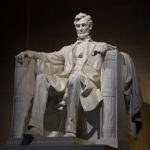
Reinhold Niebuhr called him “the most original of American religious thinkers,” this self-taught, backwoods boy who eventually became known as “Father Abraham” for freeing the nation’s slaves — and leading the North in the Civil War. Feb. 12, 2009, marked the bicentennial of Abraham Lincoln’s birth and provided an opportunity for journalists to explore Lincoln’s foundational legacy.
Lincoln is a favorite subject of Barack Obama, who took the oath of office on Jan. 20, 2009, using the same Bible that Lincoln did, and whose election as the nation’s first black president in many respects completed a vital part of the work Lincoln began.
In 2012, Stephen Spielberg’s film Lincoln hit theaters. It was nominated for twelve Academy Awards and won two. It grossed more than $275 million at the box office. The film brought the legacy of the president into the national limelight.
This edition of ReligionLink provides background and resources for reporters to delve into the thoughts and impact of the nation’s 16th president.
Background
Why it matters
Lincoln’s speeches — the Gettysburg Address and his second inaugural, for example — are virtually sacred texts in the nation’s civil religion, and Lincoln’s use of biblical imagery was powerful and deliberate.
Yet for all his impact on the national soul, Lincoln’s personal faith remains something of a mystery. Statements he made about God and religion throughout his life are sometimes contradictory, and today he is claimed as a fellow thinker by both Christians and atheists.
What were Lincoln’s real religious beliefs? He contributed to our country’s practice of our civil religion — identified by sociologist Robert Bellah as the reverence Americans have for their country’s mythology, holidays, leaders and political rituals. But how? And what values is President Obama trying to communicate that Lincoln would have recognized?
Resources
-
Abraham Lincoln Online
The Abraham Lincoln Association’s Abraham Lincoln Online is a virtual library of all things Lincoln – biographies, news, events and the 16th president’s own writings and speeches, including a collection of his statements on religion.
-
Abraham Lincoln Papers at the Library of Congress
The Library of Congress maintains a searchable online collection of Abraham Lincoln’s papers.
-
Lincoln/ Net
Lincoln/Net is a project of Northern Illinois University to put all of Lincoln’s political and personal materials online. A section on historical themes includes information on the religion and culture of Lincoln’s times.
-
Abraham Lincoln Institute
The Abraham Lincoln Institute is an organization based in Washington, D.C., that provides free informational resources about the life and work of Lincoln.
-
Abraham Lincoln Presidential Library and Museum
The Abraham Lincoln Presidential Library and Museum is in Springfield, Ill. The executive assistant is Sharon Petrilli.
-
Lincoln Studies Center
The Lincoln Studies Center is at Knox College in Galesburg, Ill. Douglas Wilson and Rodney O. Davis are co-directors.
-
Religion and the Founding of the American Republic
Religion and the Founding of the American Republic is a Library of Congress Exhibition. It provides a history of the role of religion in the founding of the United States.
-
Center for the Study of Religion and American Culture
The Center for the Study of Religion and American Culture at Indiana University-Purdue University Indianapolis explores the connection between religion and other aspects of American culture.
Other resources
-
Religion and the Presidency
What is clear is that presidents have nearly always been Protestants, with a few exceptions. The Pew Forum on Religion & Public Life has a resource page on “Religion and the Presidency” that shows the religious affiliation of all 44 presidents. “Nearly half the nation’s presidents have been affiliated with the Episcopal or Presbyterian churches,” Pew notes. “John F. Kennedy remains the only Catholic to have held the nation’s highest office. Only three U.S. presidents — Thomas Jefferson, Abraham Lincoln and Andrew Johnson — have been unaffiliated with a specific religious tradition.”
-
“Lincoln’s Religious Quest”
Read Richard Wightman Fox’s Jan. 18, 2006, article that appeared on Slate.com about Lincoln’s faith and the culture wars.
-
“The Religious Affiliation of President Abraham Lincoln”
Read an excerpt of Mark Noll’s book A History of Christianity in the United States and Canada. The section is titled “The Ambiguous Religion of President Abraham Lincoln” and is reprinted on the Web site Adherents.com.
-
“Lincoln: Spielberg’s Urgent Civics Lesson”
Read a Nov. 8, 2012, review from Time magazine of Stephen Spielberg’s 2012 film Lincoln. The review discusses the lessons to be learned from Lincoln’s legacy, and their relevance to modern-day issues.
-
“Abraham Lincoln and the costs of inequality”
Read a Nov. 26, 2012, article from The Washington Post discussing the relevance of Abraham Lincoln’s legacy to the social, political, and economic situations of today.
-
“Analysis: Film revives questions about Abraham Lincoln’s faith, but offers few answers”
Read a Nov. 20, 2012, Religion News Service analysis about how the movie Lincoln has revived questions about that president’s faith. Via the Washington Post.
National sources
-
Michael Burlingame
Michael Burlingame is a history professor emeritus at Connecticut College in New London. He wrote the 1995 book The Inner World of Abraham Lincoln and the 2008 book Abraham Lincoln: A Life.
-
Rodney Davis
Rodney Davis is co-director of the Lincoln Studies Center at Knox College in Galesburg, Ill.
-
Eric Foner
Eric Foner is a history professor at Columbia University in New York City and author of A House Divided: America in the Age of Lincoln.
-
Doris Kearns Goodwin
Doris Kearns Goodwin is one of America’s most popular historians and the best-selling author of Team of Rivals: The Political Genius of Abraham Lincoln.
-
David Grubin
David Grubin is producer and director of the PBS television special Abraham and Mary Lincoln: A House Divided, which aired as part of American Experience and included discussions of Lincoln’s faith.
-
Allen Guelzo
Allen Guelzo wrote Abraham Lincoln: Redeemer President, a 1999 book that challenged the reigning thought about Lincoln’s faith – basically, that he had little, if any. He is a professor of Civil War era history at Gettysburg College.
-
Harold Holzer
Harold Holzer is senior vice president of external affairs for the Metropolitan Museum of Art in New York City. He is also co-chairman of the Abraham Lincoln Bicentennial Commission and a member of its speakers bureau. Among the lectures he offers is “Lincoln and the Jews.” He has written several books on Lincoln.
-
Gordon Leidner
Gordon Leidner is a Lincoln scholar and former president of the Lincoln Group of the District of Columbia. He maintains the website Great American History, on which he has written about Lincoln’s religious faith. He says Lincoln’s legacy in American civil religion is that he never doubted the existence and sovereignty of God or that God had a purpose for America — and that it was our duty to determine what that will was and follow it. Leidner is in Annapolis, Md.
-
Martin Marty
Martin Marty, retired professor of religion at the Divinity School at the University of Chicago, is the author of Education, Religion and the Common Good: Advancing a Distinctly American Conversation About Religion’s Role in Our Shared Life.
He has frequently lectured on Lincoln and religious themes and gave a lecture titled“Abraham Lincoln as Theologian of America’s Public Religion” as part of the Abraham Lincoln Bicentennial Commission’s celebration.
-
Lucas Morel
Lucas Morel is an associate professor of politics at Washington and Lee University in Lexington, Va. He is the author of Lincoln’s Sacred Effort: Defining Religion’s Role in American Self-Government.
-
Mark Noll
Mark Noll is emeritus professor of history at the University of Notre Dame and one of the most cited authorities today on evangelicalism in America — as well as on the relationship between evangelicals and Roman Catholics. He co-founded the Institute for the Study of American Evangelicals at Wheaton College, where he taught for many years. Noll’s many books include America’s God: From Jonathan Edwards to Abraham Lincoln.
-
Ronald D. Rietveld
Ronald D. Rietveld is professor of history emeritus at California State University at Fullerton. He has written extensively on Lincoln, the antebellum period, the Civil War and Reconstruction, and the history of religion in America. He was a historical consultant for the Abraham Lincoln Presidential Museum and is known as the only person who found a photo of Lincoln taken in death. As a part of the Abraham Lincoln Bicentennial Commission’s celebration, he will offer lectures on Lincoln’s faith and his search for God.
-
Joshua Wolf Shenk
Joshua Wolf Shenk is the author of 2005’s Lincoln’s Melancholy: How Depression Challenged a President and Fueled His Greatness and can discuss the 16th president’s possible depression and how it may have fed his spirituality. He lives in Brooklyn, N.Y.
-
Ronald C. White Jr.
Ronald C. White Jr. is the author of two best-selling books on Lincoln, Lincoln’s Greatest Speech and The Eloquent President. White’s newest, A. Lincoln: A Biography, was published to coincide with the bicentennial. In 2006, White gave a sermon at the National Presbyterian Church in Washington, D.C., titled “Abraham Lincoln’s Sermon on the Mount.”
-
Douglas Wilson
Douglas Wilson is a co-director of the Lincoln Studies Center at Knox College in Galesburg, Ill.
-
Gary Zola
Gary Zola is an associate professor of the American Jewish experience at Hebrew Union College-Jewish Institute of Religion in Cincinnati. As part of the Abraham Lincoln Bicentennial Commission’s celebration, Zola offers a lecture on Lincoln and the Jews that examines how he helped expand their civil rights.
Regional sources
In the Northeast
-
Julie Roy Jeffrey
Julie Roy Jeffrey is a history professor at Goucher College in Baltimore. She has written about the religious landscape of the mid-19th century in relation to Lincoln’s presidency.
-
Robert Kraynak
Robert Kraynak is a political science professor at Colgate University in Hamilton, N.Y. He is the author of Christian Faith and Modern Democracy: God and Politics in the Fallen World, which examines America’s civil religion and its government.
-
Lincoln Group of the District of Columbia
The Lincoln Group of the District of Columbia is a historical society dedicated to the study of Lincoln. John Elliff is president.
-
Jon Pahl
Jon Pahl is an associate professor of church history at Lutheran Theological Seminary at Philadelphia. He has written about young people and violence and is the author of Youth Ministry in Modern America: 1930 to the Present (Hendrickson Publishers, 2000), which examines youth ministry in four traditions: Lutheran, evangelical Protestant, Roman Catholic and African-American.
In the South
-
James Byrd Jr.
James Byrd Jr. is an associate professor of American religious history at Vanderbilt University in Nashville, Tenn., where he has taught a class in religion and war in American history. He is also an expert on this story of Baptists and Methodists in the U.S. He has written two books about religion in early American religious history, one on the Revolutionary War and one on Roger Williams. He is at work on a book about the bible and the Civil War.
-
Charles Hubbard
Charles Hubbard is director of the Abraham Lincoln Library and Museum at Lincoln Memorial University in Harrogate, Tenn.
-
Richard Latner
Richard Latner is a history professor at Tulane University in New Orleans. He specializes in the history of the Civil War.
-
William Lee Miller
William Lee Miller is author of 2002’s Lincoln’s Virtues: An Ethical Biography. He is a scholar at the Miller Center of Public Affairs at the University of Virginia.
-
Chuck Queen
Chuck Queen is senior pastor of Immanuel Baptist Church in Frankfort, Ky. In 2008, he gave a sermon about the Christian directive to love one’s enemies, in which he used Lincoln’s choice of his Cabinet as a major example.
-
John Turner
John Turner teaches American history at the University of South Alabama in Mobile. He specializes in 19th-century American civil religion.
In the Midwest
-
Robert Bray
Robert Bray is a professor of English literature at Illinois Wesleyan University and the author of Peter Cartwright: Legendary Frontier Preacher. Cartwright was a contemporary of Lincoln’s and opposed him in the race for the U.S. House of Representatives in 1846, a race in which he used Lincoln’s supposed lack of religion against him.
-
Jennifer Weber
Jennifer Weber is an assistant professor of history at the University of Kansas in Lawrence, where she specializes in the Civil War. She was part of the Abraham Lincoln Bicentennial Commission’s speakers bureau and offers a lecture titled “Lincoln and Religion.”
-
Stewart Winger
Stewart Winger is an assistant professor of history at Illinois State University in Normal. His dissertation, written under Martin Marty at the University of Chicago, was titled Lincoln’s Religious Rhetoric: American Romanticism and the Antislavery Impulse. It was published as the 2003 book Lincoln, Religion and Romantic Cultural Politics.
In the West
-
Joe Wheeler
Joe Wheeler is the author of 2008’s Abraham Lincoln: A Man of Faith and Courage and a general editor for Focus on the Family. He lives in Conifer, Colo.