


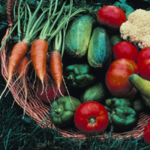
The crocuses are up, the days are growing longer, and Earth Day is almost here. Must be spring. And in back yards and window boxes – and outside houses of worship across the country – members are turning the soil and planting gardens. But it’s not just the lush beauty of flowers, plants and trees these believers are after.
Background
Like Michelle Obama, who planted her own White House vegetable patch, many congregations have embraced the notion of gardening. And they’re not motivated solely by frugality or health concerns. Feeding the trend are books and documentaries that link our nation’s food chain to many moral challenges. The annual observance of Earth Day, which falls on April 22, is another platform for connecting good ethics and good eating.
Increasingly, some congregations see the way our food is produced – by a handful of large corporations that they say put profit and industrial efficiencies ahead of health, worker safety and the environment – as an issue of justice.
Churches and synagogues are working with community organizations to plant organically grown fruit and vegetable gardens to help feed poor communities. They’re buying produce from local farmers and collecting kitchen scraps for community composting programs.
If your last story about the intersection of religion and the environment focused on how faith communities were replacing incandescent bulbs with compact fluorescents, it may be time to look at the changes afoot in the politics of food. And if you think this is just a mainline phenomenon, read deeper.
Publications
-
“The Omnivore’s Dilemma”
Written by Michael Pollan. Pollan investigates the process that brings food from the source to American’s plates and the political, economic, psychological and moral implications that entail.
-
“Food, Inc.”
Food, Inc. is a documentary in which filmmaker Robert Kenner looks at what he calls “the highly mechanized underbelly that’s been hidden from the American consumer with the consent of our government’s regulatory agencies, USDA and FDA.”
-
“The Pleasures of Eating”
A 1989 essay by farmer and author Wendell Berry about “eating responsibly.” Berry has deep Christian commitments and his books are popular among many church reading groups.
Organizations
-
Earth Day Network
The Earth Day Network was born out of the first Earth Day in 1970 and works with more than 22,000 partners in 192 countries to broaden, diversify and mobilize the environmental movement. In addition to coordinating Earth Day activities, the network, which is based in Washington, D.C., works throughout the year to promote green policies. Its website includes resources for faith groups wanting to get involved.
-
American Community Gardening Association
The American Community Gardening Association (ACGA) works build community by increasing and enhancing community gardening and greening across the United States and Canada. The ACGA works with churches and synagogues to plant organically grown fruit and vegetable gardens to help feed poor communities.
Ethics institutes
-
W. Maurice Young Centre for Applied Ethics
The W. Maurice Young Centre for Applied Ethics is located at the University of British Columbia, Vancouver, B.C. It focuses on the research on and teaching of applied ethics in fields such as science and technology, health, research, and animal welfare.
-
Emory Center for Ethics
Center for Ethics at Emory University in Atlanta focuses on the study of ethics in decision-making. The Center focuses on four pillars: health, science, and ethics; citizenship and the public good; organizational and corporate ethics; and ethics and the arts. Paul Root Wolpe is director.
-
Edmond J. Safra Center for Ethics
The Edmond J. Safra Center for Ethics at Harvard University studies and researches ethics in professional and private life. Eric Beerbohm is director.
-
Consortium Ethics Program
The Consortium Ethics Program at the University of Pittsburgh is a regional health care ethics network. It educates health care professional and institutions in clinical health care ethics. Rosa Lynn Pinkus is director.
-
Ethics Resource Center
The Ethics Resource Center is a nonprofit, nonpartisan educational organization whose vision is a world where individuals and organizations act with integrity. Its focus is organizational ethics. It is based in Arlington, Va. Contact through the website.
-
Dartmouth College Ethics Institute
The Dartmouth College Ethics Institute at Dartmouth College in Hanover, NH focuses on applied and professional ethics, ranging from medical and business ethics to teaching and research ethics. Aine Donovan is director.
-
Markkula Center for Applied Ethics
The Markkula Center for Applied Ethics at Santa Clara University in Santa Clara, Calif., is dedicated to researching modern ethical issues and attempting to create solutions in diverse fields such as bioethics, the Internet, government and character ethics.
People
-
Norman Wirzba
Norman Wirzba is professor of theology and ecology at Duke Divinity School in Durham, N.C. His research focuses on “understanding and promoting practices that can equip both rural and urban church communities to be more faithful and responsible members of creation,” specifically through eating as a spiritual discipline, theological reflection as informed by place and agrarianism as a viable and comprehensive cultural force. Wirzba’s books include (as co-author) Making Peace With the Land: God’s Call to Reconcile With Creation.
-
Peter Rosset
Peter Rosset is a food rights activist, agroecologist and rural development specialist. He is based in Oaxaca, Mexico, as a researcher at the Centro de Estudios Para el Cambio en el Campo Mexicano (Center of Studies for Rural Change in Mexico) and co-coordinator of the Land Research Action Network. He is also global alternatives associate of the Center for the Study of the Americas and an affiliated scholar of the University of California, both in Berkeley, Calif. He is the former co-director of the Institute for Food and Development Policy (Food First) in Oakland, Calif.
-
Per Pinstrup-Andersen
Per Pinstrup-Andersen is the H.E. Babcock Professor of Food, Nutrition and Public Policy at Cornell University. He is co-editor of Ethics, Hunger and Globalization: In Search of Appropriate Policies (2007). He was director general of the International Food Policy Research Institute for 10 years. He is also the J. Thomas Clark Professor of Entrepreneurship and professor of applied economics at Cornell.
-
Frances Moore Lappé
Author of Diet for a Small Planet and co-author of World Hunger: Twelve Myths. She is co-leader of the Small Planet Institute in Cambridge, Mass., and was a co-founder of the Institute for Food and Development Policy (Food First). Contact through Rod Meade Sperry, outreach and operations director.
-
Matthew Halteman
Matthew Halteman is an assistant professor of philosophy at Calvin College in Grand Rapids, Mich., where he teaches a course titled “Peaceable Kingdom: Transforming Our Relationship With Animals,” about the Christian idea of stewardship with animals. He wrote a booklet for the Humane Society of the United States titled Compassionate Eating as Care of Creation, which examines the connection between animals, food choices and faith.
-
Christine Gutleben
Christine Gutleben is director of the animals and religion program for the Humane Society of the United States. She has an undergraduate degree in religious studies and a master’s degree from a theology school, where she studied theology and ethical food choices.
-
Michael Greger
Dr. Michael Greger is a physician and director of public health and animal agriculture in the farm animal welfare division of the Humane Society of the United States. He is an expert on the public-health implications of using antibiotics and growth hormones in livestock and other food-safety issues.
-
Rynn Berry
Rynn Berry is the author of Food for the Gods: Vegetarianism & the World’s Religions and an adviser to the North American Vegetarian Society. He is based in New York City.