


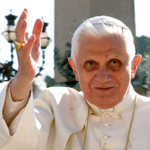
Pope Benedict XVI released his third encyclical, “Caritas in Veritate,” on Tuesday, July 7, 2009. The encyclical — an authoritative teaching document from the pope — applies Benedict’s ideas and the Catholic social justice tradition to the economic crisis.
Background
“Caritas in Veritate,” or “Charity in Truth,” builds on Benedict’s previous encyclicals on love and on hope, ties them in with Catholic social teaching, and then applies them to contemporary issues of poverty, hunger, human dignity and many others.
Moreover, the papal encyclical and the 2009 G-8 summit of leaders of the world’s top industralized nations cast a spotlight on the religious and ethical dimensions of the global economy.
On July 10, 2009, the pope welcomed President Barack Obama in a private audience at the Vatican in the first meeting between the men since Obama’s election.
The meeting drew attention to sharp divisions within the Catholic Church in the United States over Obama, whose support for abortion rights has drawn fierce criticism from some Catholics. Other Catholic leaders — including, it appears, many in the Vatican — saw convergences between many of Obama’s policies and positions the church advocates, especially as regards the economy and social welfare.
Key issues
Benedict XVI is a theologian and scholar who said he had little interest or expertise in economic issues. So this encyclical is his first major statement on social justice as pope, and perhaps his most extensive treatment of the topic in his career. That is in contrast to his predecessors Pope John Paul II and Pope Paul VI, who wrote frequently on matters of economic justice.
But the pope made his mark in other ways since his election on April 19, 2005. Here are some of them:
Emerging profile
From 1981 until his election as pope after the death of John Paul II, Joseph Ratzinger served as head of the Congregation for the Doctrine of the Faith for John Paul. The head of the CDF is responsible for safeguarding doctrine and disciplining theologians and others who are seen as straying from orthodoxy. That makes the office one of the most powerful in the Vatican and in the church, and one of the most controversial.
While Ratzinger earned a reputation as a hardliner while at the CDF, his largely unexpected election as pope did two things, observers say: One, it has allowed him to leave the controversial disciplinary action to others while allowing his pastoral side to emerge. And two, it has caused Catholics and church observers to take a fresh look at Ratzinger as pope, apart from his former role as a cardinal in the Roman Curia. Benedict XVI is the first German elected to the papacy in more than 1,000 years, and he followed a Polish pope who was the first non-Italian elected pope in more than 450 years.
Encyclicals and books
A pope’s writings are always cornerstones of his papacy and often form the core of his legacy to the church. As an esteemed intellectual, theologian and author, Pope Benedict is particularly focused on leaving an important body of work in addition to the many volumes he wrote as a cardinal.
Of his writings, several are considered most important. Two are encyclicals, the most authoritative statements a pope can issue: Deus caritas est, or “God Is Love,” signed by the pope on Dec. 25, 2005, and Spe salvi, or “Saved by Hope,” signed on Nov. 30, 2007. “Caritas in Veritate,” or “Love in Truth,” will be his third, and his first on social and economic themes.
Among the books the pope has written, two stand out in importance and popularity. Jesus of Nazareth, issued in spring 2006, was the first of a projected two-volume work on the life of Jesus Christ. The second volume covered Christ’s Passion, death and resurrection. A second book, Jesus, the Apostles and the Early Church, is a collection of Benedict’s reflections at his weekly general audience.
The Vatican Web site has a complete list of all the pope’s writings, homilies and speeches.
Homosexuals and priesthood
An effort to keep homosexuals out of the priesthood had been debated for years in the Vatican, at the initiative of then-Cardinal Ratzinger. But the policy was never implemented until Ratzinger became pope. In November 2005 the Vatican issued a document under Benedict’s signature, titled “Concerning the Criteria for the Discernment of Vocations with Regard to Persons with Homosexual Tendencies in View of Their Admission to the Seminary and to Holy Orders.” The document aimed to bar gay men from the priesthood, and it caused wide debate. At the same time, the Vatican began an inspection of U.S. seminaries in an effort to tighten up on the preparation of future priests in the wake of the clergy sex abuse scandals, including their ability to deal with celibacy. That initiative also sparked some controversy.
Ecumenism
The Vatican stirred controversy in July 2007 when the Congregation for the Doctrine of the Faith issued a statement, with Benedict’s approval, titled “Responses to Some Questions Regarding Certain Aspects of the Doctrine on the Church.” The document, in the form of answers to various questions, sought to reaffirm the Catholic Church as the one church established by Jesus Christ. That restatement angered many non-Catholics, especially in the Protestant and Orthodox churches.
Islam
Pope Benedict’s September 2006 lecture at the University of Regensburg during a homecoming visit to Bavaria included statements on Islam and the Prophet Muhammad that were highly inflammatory and led to the first major crisis of Benedict’s papacy. His visit to Turkey more than a year later, in November 2007, helped to ease tensions, and after an exchange of communications between the Vatican and Muslim scholars, a Catholic-Muslim Dialogue began in Rome in November 2008. The pope’s visit to Jordan, Israel and the Occupied Territories in May 2009 was also seen as helping to repair relations with Islam.
Jewish relations and the Latin Mass
In July 2007 the pope fulfilled a long-expected goal of restoring the pre-Vatican II Latin Rite Mass to wider use in the church. The action was controversial inside the church. Many bishops did not see the need for it, and many thought it was a way of undoing the reforms of the conciliar era. The move upset many Jewish groups because included in the restoration was a Good Friday prayer for the conversion of Jews that had been superseded by the new theological insights of the Second Vatican Council. The pope later had the prayer edited to allay fears, but concerns remain. The pope’s surprise decision in January 2009 to lift excommunications on four bishops belonging to a breakway Traditionalist sect also upset many Jews because of the association of the schismatics with anti-Semitic views.
Censuring dessent
Vatican concern remains strong when it comes to theologians and Catholic leaders who Rome believes stray from orthodox teachings. Two episodes drew headlines while underscoring this concern. The first was the March 2007 notification from Rome that some of the works of a Jesuit liberation theologian in El Salvador, the Rev. Jon Sobrino, were “either erroneous or dangerous.” The second was the news in November 2007 that the Vatican and the U.S. bishops were investigating the works of a Vietnamese-born American theologian at Georgetown University, the Rev. Peter Phan. In December 2007 the U.S. bishops’ Committee on Doctrine said that Phan’s 2004 book on religious pluralism contains “pervading ambiguities and equivocations that could easily confuse or mislead the faithful.”
News articles and research
-
“Caritas in veritate”
Read the official Vatican text of the encyclical in English.
-
“The Economy of Grace: Pope Benedict’s Social Theology”
Read a July 7, 2009, analysis by the Rev. Drew Christiansen, editor of the Jesuit weekly America and a leading Catholic social ethicist.
-
“Pope proposes a ‘Christian humanism’ for the global economy”
Read a July 7, 2009, analysis by John L. Allen Jr. of National Catholic Reporter.
-
“Pope Benedict on Economic Justice”
Read a July 7, 2009, analysis by the Rev. Thomas Reese, posted at The Washington Post site. Reese is a leading commentator on church issues.
-
“Three Misreadings of Caritas in Veritate”
Read commentary at InsideCatholic by Deal Hudson from July 20, 2009, who has consulted on Catholic issues for Republican officials.
-
“Social Encyclical Primer”
The media blog at the Web site of the United States Conference of Catholic bishops has a “Social Encyclical Primer” that sets out the history of papal encyclicals on social justice themes.
-
“Groundbreaking economic encyclical on the way”
Read a July 1, 2009, Religion News Service article, “Groundbreaking economic encyclical on the way,” by Sister Mary Ann Walsh, spokesperson for the USCCB. It’s posted at the USCCB media blog site.
-
“Economic Heresies of the Left”
Read a June 29, 2009, article at the First Things Web site, “Economic Heresies of the Left,” by Michael Novak. Novak is considered a conservative Catholic writer who defends capitalism in this essay and elsewhere against interpretations of papal teachings that some say criticize the capitalist system.
-
“In preview of new encyclical, Benedict reprises ‘dictatorship of relativism’ speech”
Read a June 29, 2009, report on the pope’s comments about the encyclical, “In preview of new encyclical, Benedict reprises ‘dictatorship of relativism’ speech,” by National Catholic Reporter columnist John L. Allen Jr.
-
“Obama Going to the Vatican”
Read a June 24, 2009, blog post at the Web site of the Jesuit magazine America, “Obama going to the Vatican,” by Michael Sean Winters.
-
“Economic encyclical expands on church’s ‘best kept secret'”
Read a June 22, 2009, analysis of the encyclical’s themes, “Economic encyclical expands on church’s ‘best kept secret’,” by National Catholic Reporter columnist John L. Allen Jr.
-
“Progressive Catholics at home in Obama administration”
Read a June 22, 2009, National Catholic Reporter story, “Progressive Catholics at home in Obama administration.”
-
“Jesuit sees convergence of U.S., Vatican policies”
The National Catholic Reporter has a June 22, 2009, podcast and summary of a story, “Jesuit sees convergence of U.S., Vatican policies,” featuring an interview with the Rev. Thomas Reese about relations between the Vatican and the Obama administration.
-
“Benedictus XVI: Activities of the Holy Father”
The Vatican Web site lists all of Benedict’s activities, meetings and writings.
National sources
-
John L. Allen Jr.
John L. Allen Jr. is editor of Crux, a website specializing in coverage of the Catholic Church. He previously was the longtime Rome correspondent for National Catholic Reporter. Allen is considered a top Vaticanologist and a leading English-language expert and commentator on the papacy.
-
Helen M. Alvaré
Helen M. Alvaré is a professor of law at George Mason University in Virginia. Alvaré chaired the commission investigating clerical abuse in the Archdiocese of Philadelphia and was an adviser to Pope Benedict XVI’s Pontifical Council for the Laity, as well as an ABC News consultant. Her scholarship regularly addresses current controversies about marriage, parenting and the new reproductive technologies.
-
Christopher Bellitto
Christopher Bellitto is chair of the history department at Kean University in New Jersey, where he has taught a course on the papacy. He has also written many articles on Catholicism and is a regular television commentator on Vatican stories.
-
Joseph Fessio
The Rev. Joseph Fessio is a close friend and former theology student of Cardinal Joseph Ratzinger, Pope Emeritus Benedict XVI. Fessio is widely considered one of the most influential conservative voices in the American church, and he is an outspoken opponent of allowing gay men into the priesthood. Fessio is the editor-in-chief of Ignatius Press in San Francisco, which was the English-language publisher for Benedict’s books. Fessio spends much of his time in Naples, Fla. Contact through Rose Trabbic, media representative for Ignatius Press.
-
John T. Ford
The Rev. John T. Ford is a professor at the school of theology and religious studies at the Catholic University of America in Washington, D.C.. He has often used Pope Benedict XVI’s books as texts in his courses on Christianity.
-
Thomas G. Guarino
The Rev. Thomas G. Guarino is a professor of systematic theology at Seton Hall University in New Jersey. He has written on the theological vision of Joseph Ratzinger.
-
Jeannine Gramick
Sister Jeannine Gramick was ordered to stop ministering to homosexuals by then-Cardinal Ratzinger in 1999. She has defied Vatican orders to cease her ministry to gay and lesbian Catholics. Contact her through the organization she co-founded, New Ways Ministry, in Mount Rainier, Md.
-
Robert P. Imbelli
The Rev. Robert P. Imbelli is an associate professor emeritus of theology at Boston College and has written and commented widely on the theology and policies of Pope John Paul II and Pope Benedict XVI.
-
J. Peter Pham
J. Peter Pham is former director of the William R. Nelson Institute for International and Public Affairs at James Madison University in Virginia. He is also a former Vatican diplomat who worked under John Paul II and is author of Heirs of the Fisherman: Behind the Scenes of Papal Death and Succession. Currently, he is the director of the Michael S. Ansari Africa Center. Pham is a frequent commentator on papal politics and processes.
-
Thomas Reese
The Rev. Thomas J. Reese is a Jesuit priest and senior analyst for Religion News Service. He writes and comments widely on Catholic culture and politics. He is the author of Inside the Vatican: The Politics and Organization of the Catholic Church.
-
Greg Tobin
Greg Tobin is senior adviser for communications at Seton Hall University in New Jersey and author of Holy Father: Pope Benedict XVI: Pontiff for a New Era.
-
George Weigel
George Weigel is an orthodox-minded Catholic theologian and distinguished senior fellow at the Ethics and Public Policy Center in Washington, D.C. He is the author of God’s Choice: Pope Benedict XVI and the Future of the Catholic Church (2005) and Witness to Hope (1999), which is essentially the authorized biography of Pope John Paul’s papacy. Weigel also wrote The End and the Beginning: Pope John Paul II : The Victory of Freedom, the Last Years, the Legacy (2010).
-
The Vatican
The official website of the Holy See.
Regional sources
In the Northeast
-
Lisa Sowle Cahill
Lisa Sowle Cahill is a professor of theology at Boston College who has written about genetics from a Christian perspective. Her books include Theological Bioethics: Participation, Justice and Change and Bioethics and the Common Good.
-
Alice Laffey
Alice Laffey is an associate professor of religious studies at College of the Holy Cross in Worcester, Mass. She has written a history of papal statements and the evolution of papal teaching, and she can address issues regarding women and gender.
-
Stephen Pope
Stephen Pope is a professor of theology at Boston College and a frequent commentator on church affairs and the papacy. He is author of The Evolution of Altruism and the Ordering of Love and writes about different forms of love in Christian thought, Christian ethics, justice, and charity, and evolutionary theory.
-
John S. Grabowski
John S. Grabowski is an associate professor of religious studies at the Catholic University of America in Washington, D.C. He also has an expertise in women’s issues. He and his wife were appointed to the Pontifical Council for the Family by Pope Benedict XVI in the fall of 2009.
-
Robert Wister
The Rev. Robert Wister is a leading expert on the history of the papacy. He is a professor of church history at Seton Hall University in New Jersey. He earned a doctorate in church history at the Gregorian University in Rome.
In the South
-
Mark Ellingsen
Mark Ellingsen is an associate professor at the Interdenominational Theological Center in Atlanta. He is the author of the article “Joseph Ratzinger: How Conservative is Benedict XVI?” in the October 2005 issue of Theology Today.
-
Gerald P. Fogarty
The Rev. Gerald P. Fogarty is a professor of religious studies and history at the University of Virginia and an expert on the Vatican. He is the author of several books on Catholicism and the papacy. His essay “The Papacy: From Low Regard to High Esteem” is part of a 2000 collection from Liturgical Press titled The Catholic Church in the Twentieth Century.
-
Peter J. Bernardi
The Rev. Peter J. Bernardi is an associate professor of religious studies at Loyola University in Chicago. He can talk about the papacy in the contemporary world. He contributed an essay to the collection in Catholicism Contending With Modernity: Roman Catholic Modernism and Anti-Modernism in Historical Context.
-
William F. Maestri
The Rev. William F. Maestri is a theologian and spokesman for the Archdiocese of New Orleans with a specialty in bioethics. He can talk about Pope John Paul II’s philosophical defense of human dignity in all contexts — medical, economic, etc.
-
Charles E. Curran
Charles E. Curran is the Scurlock Professor of Human Values at Southern Methodist University in Dallas. He specializes in moral theology, social ethics and the role of the church as a moral and political actor in society. He is a liberal theologian who was dismissed from Catholic University of America for his teachings on human sexuality after an extended struggle, which included meetings with then-Cardinal Joseph Ratzinger. Curran can also comment on the politics of the papacy.
In the Midwest
-
Steven M. Avella
The Rev. Steven M. Avella is associate professor of history at Marquette University in Milwaukee and an expert on American Catholic history and the history of the American West.
-
Dennis Doyle
Dennis Doyle is a professor of religious studies at the University of Dayton and a frequent commentator and author on Catholic issues and the papacy.
-
Michael A. Fahey
The Rev. Michael A. Fahey is professor emeritus of theological studies at Marquette University in Milwaukee. He is an expert on the history and office of the papacy, and papal elections.
-
Sandra Yocum
Sandra Yocum is chair of religious studies at the University of Dayton who specializes in the history of theology, which is Benedict’s forte.
In the West
-
James Eblen
The Rev. James Eblen is a professor emeritus in Seattle University’s school of theology and ministry who can speak about the papacy.
-
Patrick Howell
The Rev. Patrick Howell is vice president for mission and ministry at the School of Theology and Ministry at Seattle University. He co-edited the book Empowering Authority: The Charisms of Episcopacy and Primacy in the Church Today. He has frequently written about Pope Benedict XVI for the Seattle Times.
-
Thomas P. Rausch
The Rev. Thomas P. Rausch is a professor of theology at Loyola Marymount University in Los Angeles. A Catholic priest, Rausch is the author of Authority and Leadership in the Church: Past Directions and Future Possibilities.
Related source guides
-
Assessing Benedict XVI: Resources for covering the pope
-
Assessing the first year of Pope Benedict XVI
-
Fallout: the pope and Islam
-
Liberation theology redux: A new pope revives an old debate
-
Pope Benedict XVI resigns: Resources for covering the historic development
-
The new pope: Resources for reporters
-
The reign of Pope John Paul II