


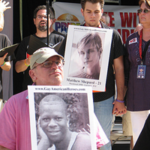
A landmark hate-crimes bill expanding federal statutes to include protections for people of the LGBTQ community was signed into law on Oct. 28, 2009 by President Barack Obama. The law is a landmark achievement for the gay community but a dividing line for some religious groups.
Background
The law is often called the Matthew Shepard and James Byrd Jr. Hate Crimes Prevention Act, after the young gay man beaten to death in Laramie, Wyo., in October 1998 and the African-American man dragged to his death behind a pickup truck in Texas in June of that year.
The two acts of violence, born of prejudice, galvanized activists to seek hate-crimes protection for lesbian, gay, bisexual and transgender people.
But the path from these killings to a federal law has been arduous. As Wikipedia’s entry on the subject shows, the first version of an expanded hate-crimes bill was introduced in April 2001, in the 107th Congress, and follow-ups have been reintroduced each time it stalled, up through the 111th Congress.
Public opinion
Gauging public opinion, especially when it comes to bias regarding sexual orientation, race or ethnicity, can be tricky, experts say.
For example, polls have consistently shown wide support for expanding hate-crime laws. A May 2007 Gallup survey showed that by a 78-18 percent ratio, Americans favored existing hate-crime laws for acts “committed on the basis of the victim’s race, color, religion or national origin.” That ratio dropped slightly, to 68-27 percent in favor, when respondents were asked whether sexual orientation and gender identity should be included. Support for such an expansion was 60 percent or higher among Republicans and weekly church attenders as well.
Yet many conservative Christian groups have been strongly opposed to the expansion of federal hate-crime legislation, and in 2007 the White House said President George W. Bush would veto a bill if it reached his desk. While condemning hate crimes as heinous, some conservative Christian groups fear that preaching against homosexuality, which they consider sinful, could be deemed a hate crime under the legislation. Further, they say clergy could be prosecuted if someone committed a hate crime because of a sermon or pastoral counseling labeling homosexuality immoral. Many constitutional specialists say these fears are groundless, as such speech would be protected by the First Amendment.
Among other religious groups, many Jewish organizations and the major Muslim and Sikh associations support the bill. They say their religious principles demand equal protection of all people.
Experts say the ongoing battles over legalizing gay marriage may have contributed to the sense of polarization and anger on the issue.
Why it matters
Concern is growing that hate crimes against all groups are on the rise, fueled by economic downturn and the increasingly rancorous tone of discourse in American society. That anger often cues off the election of Obama as the first African-American president as well as fears of “big government” policies. It can also be wrapped in religious language, even though most religious traditions oppose bigotry and violence. There is a further divide in that many religious groups support a broadened federal hate-crimes law while others worry that such a measure would threaten their constitutional right — and God-given duty — to speak out on moral issues.
News articles and research
-
“Obama signs hate crimes bill into law”
Read an October 28, 2009, story on CNN.com about President Obama signing a bill that makes it a crime to assault someone based on their sexuality or gender.
-
“New FBI Hate Crime Statistics Confirm Need for Stronger Federal Response “
An analysis of the statistics by Human Rights First shows that while the number of hate crimes remained steady from 2006 to 2007, the number of attacks targeting Hispanics and LGBT people rose. The FBI reports showed a 3.3 percent rise in anti-Hispanic hate crimes and a 5.5 percent rise in the number of hate crimes motivated by a sexual orientation bias. The analysis notes that sexual orientation bias crimes “continue to be characterized by a high level of violence” and that five of the nine reported hate crime killings were committed on the basis of sexual orientation bias. “There is also a higher proportion of personal assaults than in other categories of hate crime,” it says. “Over 47 percent of sexual orientation bias offenses were violent assaults, in comparison to 31 percent for all hate crimes.”
-
“The enemies within”
In April 2009, the Department of Homeland Security released a report detailing concerns about a rise in right-wing extremism. In The New York Times columnist Charles Blow parses the figures and uses a graphic to illustrate the dependence of right-wing hate groups on recruits with military training.
-
“Poplawski was ‘Braced for Fate’ in days leading to attack”
Several high-profile hate crimes have made headlines in 2009, confirming fears for some that bias attacks are on the rise. They include the April killing of three Pittsburgh policemen by a right-wing extremist and the shooting in June at the Holocaust Museum in Washington by an elderly white supremacist that left a security guard dead.
-
“Some Link Economy With Spate Of Killings”
An April 8, 2009, story in The Washington Post, “Some Link Economy With Spate Of Killings,” examines links between the recession and 57 killings in eight mass-murder crimes over the course of a single month last spring.
-
“H.R. 1913 (111th): Local Law Enforcement Hate Crimes Prevention Act of 2009”
The Library of Congress’ online service has information on the House bill, known as H.R. 1913. The Senate bill is S. 909 and can be found here. Govtrack.us followed the path of the bill.
-
“Hate Crimes Accounting: Annual Report Released”
In addition to the new hate-crimes law, the FBI released its annual report on Hate Crime Statistics. The report detailed hate crimes from 2011. More than 6,222 hate crimes were reported in 2011.
-
“Hate crimes — the ugly face of racism, anti-Semitism, anti-Gypsyism, Islamophobia, and homophobia”
Article about hate crimes in Europe.
-
“Hating the Hate Crimes Bill”
Read an Oct. 13, 2009, blog post at “On Faith” by David Waters about the religiously based opposition to the hate-crimes bill.
-
“Letter from Conservative Leaders Implores Senators to Filibuster Hate Crimes Bill”
Read a June 16, 2009, Christiannewswire.com story about a letter from 60 religious conservatives asking senators to filibuster the hate-crimes bill then under consideration for fear it would “criminalize preaching the Gospel and put preachers in the crosshairs.” Among the signers were James Dobson of Focus on the Family, Tony Perkins of the Family Research Council, Don Wildmon of the American Family Association, Gary Bauer of American Values, Phyllis Schlafly of the Eagle Forum and Wendy Wright of Concerned Women for America.
-
“U.S. Hate Groups Top 1,000”
The Southern Poverty Law Center, which tracks hate groups and domestic terrorism, in February 2011 released an annual report showing “explosive growth” in the number of active hate groups in the United States and in the number of antigovernment “Patriot” movements. These groups often have a religious element to their agendas.
-
“Crime to Denounce Homosexuality?”
Factcheck.org has an analysis to address the concern over whether a hate-crime law covering sexual orientation could lead to charges against pastors who preach that homosexuality is a sin. Factcheck.org says no, but Catholic League head Bill Donohue — who has expressed strong reservations about the bill — disputed that analysis in a news release.
-
“Surveillance video captures brutal beating of gay man, Jack Price, in Queens; Both suspects arrested”
A brutal Oct. 8, 2009, beating in New York City by two attackers left an openly gay man in a coma. The beating was classified as a hate crime; it was caught on a surveillance video and made headlines around the country.
-
“RDBook: Christian White Nationalism in the Age of Obama”
Read an April 27, 2009, interview at ReligionDispatches.org with Leonard Zeskind, author of a new book, Blood and Politics: The History of the White Nationalist Movement From the Margins to the Mainstream. Among other things, the book describes the religious roots of the movement.
-
U.S. hate crimes
ReligiousTolerance.org has a Web page of hate-crime definitions and existing laws and another on hate-crime laws and sexual orientation. It also has a page dedicated to the question of whether hate-crimes legislation limits free speech.
-
UUA: Standing on the Side of Love
In June 2009, the Unitarian Universalist Association launched a campaign against hate crimes called “Standing on the Side of Love.” The campaign was a response to a July 27, 2008, attack on the Tennessee Valley Unitarian Universalist Church that killed two people and wounded seven. The gunman told authorities he was angered by the church’s acceptance of homosexuality and other liberal causes.
-
Active U.S. Hate Groups
The Southern Poverty Law Center has a state-by-state map of identified hate groups. The center says that in 2012 there were 1,007 hate groups operating throughout the United States, an increase of more than 50 percent since 2000.
-
State and Local Response to Hate Crimes
Partners Against Hate maintains a state-by-state database of hate-crime statistics and hate-crime laws.
-
Uniform Crime Reports
The FBI’s has an index of all hate crime statistics since 1995.
National sources
Religious organizations
-
Anti-Defamation League
The Anti-Defamation League tracks discrimination based on religion. ADL has 30 regional offices. Check with local ADL officials for a breakdown on the number and type of antisemitic incidents in your area and for leads on interfaith initiatives.
-
Council on American-Islamic Relations
The Council on American-Islamic Relations says it is the largest advocacy group for Muslims in the U.S. It advocates for Muslims on issues related to civil liberties and justice. Contact communications director Ibrahim Hooper in Washington, D.C.
-
Hindu American Foundation
The Hindu American Foundation is an advocacy organization for the Hindu American community. The foundation educates the public about Hinduism, speaks out about issues affecting Hindus worldwide and builds bridges with institutions and individuals whose work aligns with HAF’s objectives. HAF focuses on human and civil rights, public policy, media, academia and interfaith relations. It is based in Washington, D.C.
-
Religious Action Center of Reform Judaism
The Religious Action Center of Reform Judaism is the advocacy arm of the Union for Reform Judaism. Rabbi David Saperstein is its director and counsel.
-
Muslim Advocates
Muslim Advocates uses legal advocacy, policy engagement and education to promote rights for Muslims and others. Contact executive director Farhana Khera.
-
Sikh Coalition
The Sikh Coalition in New York is an advocacy group established by several Sikh groups across the United States after the 9/11 attacks to help protect Sikh civil rights.
-
Muslim Public Affairs Council
The Muslim Public Affairs Council works for Muslim participation in civic life. It works to cultivate leadership in young Muslims and encourage a sense of ownership over their religious and national identity as Americans. The group’s $1.1 million budget includes no overseas funding. It has offices in Washington, D.C., and Los Angeles and has several state chapters. The council is considered moderate and politically savvy and is led by first- and second-generation Americans. Salam Al-Marayati is president and co-founder.
-
Simon Wiesenthal Center
The Simon Wiesenthal Center in Los Angeles is an international Jewish human rights organization dedicated to preserving the memory of the Holocaust by fostering tolerance and understanding. The center also focuses on contemporary issues, including racism, antisemitism, terrorism and genocide.
It maintains the National Institutes Against Hate Crimes and Terrorism to train criminal justice professionals.
Secular organizations
-
American Civil Liberties Union
The American Civil Liberties Union litigates on behalf of civil liberties, including religious liberties. It is based in Washington, D.C., and has many chapters throughout the United States. Anthony D. Romero is its executive director.
-
Human Rights Campaign
The Human Rights Campaign is the country’s largest civil rights organization working for sexual equality. Its Religion & Faith Program supports programming efforts in many different groups and also offers its own resources and event support for religious LGBT advocacy.
-
The Leadership Conference on Civil Rights
The Leadership Conference on Civil Rights is an umbrella organization of more than 200 smaller organizations that works to promote human rights throughout the U.S. Wade Henderson is president and CEO, and Nancy Zirkin is the group’s policy director.
-
The National Coalition of Anti-Violence Programs
The National Coalition of Anti-Violence Programs tracks incidents of violence and harassment against LGBT people. Clarence Patton is acting executive director.
-
Partners Against Hate
Partners Against Hate works to educate young people about hate and hate crimes. It is based in Washington, D.C. Contact 202-452-8310.
-
The Southern Poverty Law Center
The Southern Poverty Law Center is a civil rights legal advocacy group based in Montgomery, Ala. Email through the website.
-
The Vera Institute of Justice
The Vera Institute of Justice works to improve justice services and systems through research and projects. Nicholas Turner is the president and director.
Supporters of the hate-crime legislation
-
The International Association of Chiefs of Police
The International Association of Chiefs of Police is a professional organization of law enforcement personnel that works to confront new challenges in policing and promote member success. Contact Sarah Guy, the manager of legislative and media affairs.
-
Integrity USA
Integrity USA is an organization that calls for full and equal inclusion of lesbian, gay, bisexual and transgender people in the Episcopal Church.
-
Unitarian Universalist Association of Congregations
The Unitarian Universalist Association of Congregations works to connect individual congregations with others across the U.S. Contact the executive assistant for the office of the president, Stephanie Carey Maron.
Opponents of the hate-crime legislation
-
Advance USA
Advance USA promotes Judeo-Christian religious values. It is based in Independence, Mo., and maintains a Washington, D.C. office.
-
Shari Rendall
Shari Rendall is director of legislation and public policy for Concerned Women for America, a conservative group that aims to bring biblical principles to all levels of public policy.
-
Concerned Women for America
Concerned Women for America aims “to bring Biblical principles into all levels of public policy.” Issues dealing with sanctity of life are among its core concerns. Penny Young Nance is chief executive officer and president.
-
Brad Dacus
Brad Dacus is president of the Pacific Justice Institute of Sacramento, Calif. The institute is a religious liberty advocacy organization that has litigated on behalf of churches such as the Independent Baptist Church of Sacramento in land use cases.
-
James Dobson
James Dobson is founder and former president and chairman of the board of Focus on the Family. In 2010, he founded a new ministry called Family Talk.
-
Andrea Lafferty
Executive director of the Traditional Values Coalition, a lobbying group dedicated to promoting Bible-based values in the nation’s laws.
-
Richard Land
Richard Land is president of the nondenominational Southern Evangelical Seminary in Charlotte, N.C., and previously served for 25 years as president of the Southern Baptist Convention’s Ethics & Religious Liberty Commission.
-
Family Research Council
The Family Research Council is a Christian organization promoting the traditional family unit and the Judeo-
Christian value system. Press contacts are J.P. Duffy or Alice Chao. -
Russell Moore
Russell Moore is editor-in-chief of Christianity Today. Named in 2017 as one of Politico Magazine’s top 50 influence-makers in Washington, Moore was previously president of the Southern Baptist Convention’s Ethics & Religious Liberty Commission.
-
R. Albert Mohler Jr.
R. Albert Mohler Jr. is president of the Southern Baptist Theological Seminary in Louisville, Ky., and hosts a weekday call-in radio program. In 2001, he chaired the executive committee of the Greater Louisville Billy Graham Crusade. Mohler’s blog often mentions Graham.
He has written a blog post describing the hate crimes law as “dangerous” as it would open the door to all manner of gay rights and other claims.
-
Janet Porter
Janet Porter is the president and founder of Faith2Action, a Christian advocacy group that works to influence politics and legislation. The group is based in Dania Beach, Fla.
She wrote a commentary against the bill for World Net Daily.
-
Alliance Defense Fund
The Alliance Defense Fund opposes same-sex marriage and efforts to circumvent DOMA.
Glen Lavy of the group wrote a letter to Congress in 2007 asking lawmakers to vote against the bill.
-
Repent America
Repent America is a Philadelphia-based evangelistic organization that works against homosexuality, abortion and evolution.
The group posts a “‘Hate Crimes Packet” on its Web site.
Hate-crimes experts
-
Gregory M. Herek
Gregory M. Herek is a psychologist at the University of California, Davis. He is a well-known scholar in the areas of prejudice against lesbians and gay men, hate crimes and anti-gay violence, and AIDS-related stigma.
-
Brian Levin
Brian Levin is director of the Center for the Study of Hate & Extremism, a nonpartisan research and policy center at California State University, San Bernardino. Levin is also a professor of criminal justice at the university.
-
Rebecca Stotzer
Rebecca Stotzer is an assistant professor in the School of Social Work at the University of Hawaii at Manoa. Her research includes studies on racial and sexual discrimination.
First Amendment specialists
-
Mathew D. Staver
Mathew D. Staver is founder and chairman of the Liberty Counsel, a civil liberties education and legal defense organization in Orlando, Fla., that focuses on freedom of speech and religious freedom.
Legal resources
-
Supreme Court of the United States
The official website of the Supreme Court of the United States posts background information about the court, as well as court decisions and arguments.
-
United States courts
The website of the federal judiciary — which includes the U.S. Court of Appeals, district courts and bankruptcy courts — posts court records, judicial statistics and information on judges. Contact through the website.
-
FindLaw.com
FindLaw.com post links to case law and texts. Contact through the website.
Regional sources
In the Northeast
-
Frederick Lawrence
Frederick Lawrence is a theology professor at Boston College and the author of Punishing Hate: Bias Crimes Under American Law.
-
The Massachusetts Family Institute
The Massachusetts Family Institute is an organization that promotes marriage as between a man and a woman.
-
Stephen Wessler
Stephen Wessler is the former executive director of the Center for the Prevention of Hate Violence, based in Portland, Maine. Before it closed, the center offered anti-bullying workshops in schools across the nation. Wessler is now training and consulting on a variety of civil rights and human rights issues both in Maine, elsewhere in the US and in Europe.
-
Bishop Kwabena Rainey Cheeks
Bishop Kwabena Rainey Cheeks is pastor of Inner Light Ministries in Washington, D.C., and a supporter of the legislation.
-
Harry R. Jackson Jr.
Pastor Harry R. Jackson Jr. is pastor of Hope Christian Church in Lanham, Md. He also heads the High Impact Leadership Coalition.
-
James B. Jacobs
James B. Jacobs is director of the Center for Research in Crime and Justice at New York University, where he is also a law professor. He is co-author of Hate Crimes: Criminal Law & Identity Politics.
In the South
-
Kimberly Daniels
Kimberly Daniels is an evangelical preacher based in Jacksonville, Fla., and founder of Kimberly Daniels Ministries International.
-
James Davison Hunter
James Davison Hunter is Labrosse-Levinson Distinguished Professor of Religion, Culture and Social Theory at the University of Virginia and executive director of the Institute for Advanced Studies in Culture. He is a frequent writer and commentator on the culture wars dividing America, especially as regards homosexuality. Contact Hunter through his assistant.
-
Erin Swenson
Erin Swenson, a who lives in the Atlanta area and was ordained in 1973 as Eric Karl Swenson by the Presbyterian Church (U.S.A.), in 1996 openly changed gender while working as a pastor. She is a licensed marriage therapist in Atlanta, Ga., where she works with individuals and families on gender identity issues.
-
Nancy Wilson
The Rev. Elder Nancy Wilson of Sarasota, Fla., is the moderator of Metropolitan Community Churches.
-
Center for the Study of Law and Religion
The Center for the Study of Law and Religion at Emory University in Atlanta focuses on religion and the law worldwide. It is headed by John Witte Jr., a professor of law and ethics and an expert on religious liberty.
-
Brian K. Pennington
Brian K. Pennington is an associate professor of religion at Maryville College in Maryville, Tenn. He has written about Hindu-Christian relations and religious violence.
-
Timothy Hall
Timothy Hall is an associate professor of philosophy at Oberlin College & Conservatory in Oberlin, Ohio. He teaches a variety of ethics courses, and his research interests include the applied ethics of gun control.
-
Thomas R. McCoy
Thomas R. McCoy is a professor of law emeritus at Vanderbilt University in Nashville, Tenn. He retired from the university in 2008 but continues to speak frequently on First Amendment issues and advises the Freedom Forum’s First Amendment Center.
-
Susan McPherson
In 2011, Susan McPherson rejoined Wallace, Jordan, Ratliff and Brandt as an associate in Birmingham, Ala., where she specializes in appellate litigation. She is also a member of the Birmingham chapter of the Christian Legal Society.
-
Christopher Marsh
Christopher Marsh is director of the J.M. Dawson Institute of Church-State Studies at Baylor University in Waco, Texas. The institute works to advance religious liberty in the United States and around the world. Marsh’s research interests include religion and violence.
In the Midwest
-
Jeannine Bell
Jeannine Bell is a law professor at Indiana University in Bloomington and the author of Policing Hatred: Law Enforcement, Civil Rights and Hate Crime.
-
Craig Mousin
Craig Mousin is director of the Center for Church-State Studies at DePaul University law school in Chicago. The nondenominational center promotes debate and discussion about the First Amendment and the Establishment Clause.
-
Carlton Pearson
Bishop Carlton Pearson is senior pastor of New Dimensions Worship Center in Chicago, a Pentecostal Christian church.
-
Charles E. Bouchard
The Rev. Charles E. Bouchard, O.P., is a moral theologian and president of the Aquinas Institute of Theology, a Dominican graduate school in St. Louis.
He gave a speech in favor of the bill at an April 17, 2007, rally organized by the Human Rights Campaign.
-
Marvin Winans
Marvin Winans is pastor of Perfecting Church in Detroit and an award-winning gospel singer.
He was part of a group of African-American pastors who met with U.S. Rep. John Conyers to lobby against the bill.
In the West
-
Miguel A. De La Torre
Miguel A. De La Torre teaches social ethics at Iliff School of Theology in Denver, where he directs the school’s Justice and Peace Institute. Issues he can discuss include religion’s effects on class/race/gender oppression, Santeria, Cuba and liberation theology. His numerous books include, as co-editor, Rethinking Latino(a) Religion and Identity and Handbook of Latina/o Theologies.
-
Alan E. Brownstein
Alan E. Brownstein is a professor of constitutional law at the University of California, Davis. He is a nationally known expert on religious freedom issues and has written widely about religious land use issues and states’ rights.
-
Edward Tabash
Edward Tabash is a civil rights attorney and chairman of the National Legal Committee for Americans United for Separation of Church and State. He is also chairman of the First Amendment Task Force of the Council for Secular Humanism. He lives in Los Angeles, Calif. Contact via his website.
-
Valerie Jenness
Valerie Jenness is a professor of criminology, law and society at the University of California, Irvine. She is the co-author of two books on hate crimes, including Making Hate a Crime: From Social Movement to Law Enforcement.
-
Denise Eger
Denise Eger is the rabbi of Congregation Kol Ami in West Hollywood, Calif. She is a well-known activist, most specifically with organizations devoted to fighting AIDS as well as on LGBT issues. The synagogue’s religious school has LGBT students and children of LGBT parents, and the rabbi runs a teen support group at the synagogue twice a month. The congregation has also coordinated with other local synagogues and schools on youth issues.