


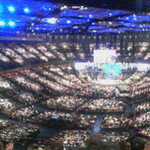
Twenty years ago, megachurches might have rated an asterisk in a journalistic overview of U.S. Christianity. Today, an estimated 12 million Americans consider one of these mammoth congregations to be their church home, making the megachurch phenomenon one of the most important for religion in modern times.
Moreover, some of the most prominent pastors in the U.S. today are megachurch clergy, including Rick Warren and Joel Osteen. Their profiles and messages — through best-selling books, speaking tours and television broadcasts — have a visibility and audience beyond the large congregations they preach to every weekend.
What’s behind the accelerated growth of these churches? What are the implications for congregations – and in some cases denominations – that are left behind? How might megachurches shape the Christianity of tomorrow? Too often, misconceptions affect Americans’ understanding of these matters and more. ReligionLink offers sources and background for exploring the questions.
Background
Why it matters
It’s been estimated that megachurches represent just one-half of 1 percent of all U.S. religious congregations but that they account for roughly 10 percent of churchgoing Protestants. As a result, megachurches are reshaping the religious landscape – and in some cases their surrounding secular communities, as well. In addition, the megachurch story is a global story, as the explosive growth of Christianity in Asia and Africa has been accompanied by a rise in huge congregations.
The basics
Just what is a megachurch? Academics apply the term to Protestant congregations averaging at least 2,000 worshippers at weekly services. There are at least 1,200 megachurches in the U.S., according to the Hartford Institute for Religion Research. More than 43,000 people a week attend the biggest one, Lakewood Church in Houston, according to Forbes magazine — but the Hartford Institute says even Lakewood is dwarfed by some megachurches elsewhere in the world, particularly South Korea.
Story angles
Story possibilities involving megachurches are nearly as vast as the churches themselves. Here are just a few:
Going off-label? The 2007 book Beyond Megachurch Myths: What We Can Learn From America’s Largest Churches details a number of misconceptions about megachurches. One of the most common is that they’re all nondenominational; in reality, about two-thirds are affiliated with a national denomination, with Southern Baptists claiming the largest share (16 percent), say the book’s co-authors, Scott Thumma and Dave Travis. Even so, megachurches often downplay the denominational connection, and their very size tends to foster a sense of independence. Many don’t rely on denominations, for example, for educational resources or mission trips – they simply create their own. How does this functional independence affect denominations? What tensions or possible benefits result from it? What is the relationship between megachurches and denominations in your area?
Different schools of thought? Megachurches also tend to be less dependent than other churches on seminaries. The largest churches often cultivate and train their own leaders from within; some pastors – most famously, Joel Osteen – are not seminary graduates. Meanwhile, the recession has left some seminaries struggling. What does the megachurch model mean for the future of seminaries, especially in light of the difficult economy? What are the challenges for seminaries in preparing students for very large as well as very small congregational environments? How does a lack of formal seminary training affect pastoral leadership and ultimately congregants’ spiritual growth?
The elephant in the neighborhood? Multisite campuses are becoming common for megachurches. Advantages can include convenience for outlying members and less impact on the main campus’s neighbors than expansion of the central site would cause. The arrangement can have downsides, too, though. How do megachurches in your area see it? Has rapid membership growth brought conflict with other property owners over land use and traffic? Do neighborhood associations and municipalities prefer the satellite approach rather than one supersize campus? What are multisite churches doing to encourage a sense of unity among their campuses?
What next? Megachurches are known for embracing new ways of doing things, from worship and music styles to social networking. What trends and tools are they experimenting with in your area? Is virtual/online worship being tried? If so, what’s been the response?
Extra-large help for extra-large needs? For some churchgoers, size can mean important programs and services that might not be possible at a smaller church. Parents of children with autism or other disabilities, for example, may find that megachurches are better-equipped to meet their needs because there are multiple families in the congregation with similar situations. Check with local churches, parents and advocacy groups to see if this is the case in your city.
Competition or cooperation? What kinds of relationships have developed between your community’s megachurches and nearby congregations? Are they collegial, strained or something in between? Some megachurches offer conferences and coaching to leaders of smaller churches. What’s happening in your town?
Growing pains? In 2008, one of the nation’s biggest churches, Willow Creek Community Church in suburban Chicago, began shifting away from “seeker-centered” services in order to better meet the needs of more spiritually mature believers. The decision came after a study found that many of those members felt stalled or dissatisfied with the church. Have other seeker-oriented churches followed suit? What are megachurches in your area doing to accommodate the spectrum of members’ spiritual maturity levels?
Economic stimulant, or unfair advantage? Some megachurches have shown an entrepreneurial streak, with cafes, bookstores, athletic facilities and even retail and residential developments. Advocates say these activities provide jobs and other benefits, but critics suggest that they might also unfairly compete with private business – and cause people of other faiths to feel excluded from community gathering spots. Has this been an issue in your city?
Resources and background
-
Hartford Institute for Religion Research
The Hartford Institute for Religion Research at the Hartford Seminary is an excellent resource and includes a database of more than 800 megachurches in the United States. Contact Scott Thumma, professor of the sociology of religion at Hartford Seminary.
Articles and other media
-
“Megachurches Offer Relational Approach with Multiple Sites”
Read a Sept. 25, 2009, Crosswalk.com article about the trend toward multisite megachurches.
-
“Seminary Plants”
Read an Aug. 12, 2009, Christianity Today article about megachurches training future pastors themselves rather than drawing from established seminaries.
-
“How Faith Varies by Church Size”
The Barna Group, a Christian research company, released a report on August 10, 2009, that found links between congregational size and the members’ theological beliefs, religious behaviors and demographic characteristics, including political leanings. The report says, for example, that those who attend megachurches are more likely to be Republicans.
-
“Faith and Politics in Church: New Study Suggests Size Matters”
A leading scholar on megachurches concurred with some of the findings of a 2009 Barna study on congregations and religious and political beliefs, but disagreed on others, according to this Aug. 12, 2009, Newsweek/Washington Post On Faith blog post.
-
“Mega-mirror”
Read an Aug. 6, 2009, Christianity Today editorial that asks whether megachurches — and smaller ones, too — ought to pay more attention to cultivating a “gospel culture” and less attention to cultivating growth.
-
“America’s Biggest Megachurches”
Read a June 26, 2009, Forbes magazine article on megachurches. It includes descriptions and photos of the nation’s 10 biggest ones and a Q-and-A with Joel Osteen, pastor of Houston’s Lakewood Church.
-
“Mark Chaves: Congregational size”
Read a March 10, 2009, blog post by Duke University professor Mark Chaves about how congregational size is changing America’s religious landscape.
-
“Willow Creek’s ‘Huge Shift'”
Read a May 15, 2008, Christianity Today article about a shift by one of the best-known megachurches, Willow Creek Community Church in suburban Chicago, away from “seeker-centered” services in order to better meet the needs of more spiritually mature believers.
-
“Megachurches Add Local Economy to Their Mission”
Read a Nov. 23, 2007, New York Times article about megachurches’ entrepreneurial activities and the perceived benefits and drawbacks for the wider community.
-
“Product Placement in the Pews? Microtargeting Meets Megachurches”
Read a Nov. 15, 2006, article about product placement and other marketing strategies targeting megachurches. The article is posted at the University of Pennsylvania’s Knowledge@Wharton site.
-
“Megachurches’ way of worship is on the rise”
Read a Feb. 6, 2006, Christian Science Monitor article about the rise of megachurches.
-
“Megachurches, megabusinesses”
Read a Sept. 17, 2003, Forbes magazine article on entrepreneurial and marketing activities of megachurches.
-
“In the Shadow of a Giant”
Read a 2001 article by the former pastor of a small Illinois church about his experience ministering in the shadow of a megachurch. It ran in the Enrichment Journal, a publication of the Assemblies of God.
National sources
-
Warren Bird
Warren Bird is director of research and intellectual capital for Leadership Network, a nonprofit organization that works to foster Christian leadership, innovation and church growth. He has studied and profiled many of the nation’s biggest and fastest-growing churches and is a co-author of A Multi-Site Church Road Trip: Exploring the New Normal. Bird’s dissertation in 2007 examined whether megachurches foster “spectator religion”; he concluded that they don’t. Bird lives near New York City.
-
Stephen Ellingson
Stephen Ellingson is assistant professor of sociology at Hamilton College in Clinton, N.Y., and co-editor of Religion and Sexuality in Cross-cultural Perspective (Routledge, 2002).
He also wrote The Megachurch and the Mainline: Remaking Religious Tradition in the Twenty-first Century, which won the 2007 Distinguished Book Award from the Society for the Scientific Study of Religion.
-
Roger Finke
Roger Finke is a professor of sociology, religious studies and international affairs at Penn State University. He’s also director of the Association of Religion Data Archives.
He co-authored The Churching of America, 1776-2005: Winners and Losers in Our Religious Economy and can discuss the role of megachurches in the competitive religious marketplace.
-
Gerardo Martí
Gerardo Martí is a sociology professor at Davidson College, Davidson, North Carolina. He teaches about race and ethnic relations and is the author of A Mosaic of Believers: Diversity and Innovation in a Multiethnic Church. Martí is researching whether worship music matters for making congregations racially and ethnically diverse.
He is also the author of Hollywood Faith: Holiness, Prosperity and Ambition in a Los Angeles Church (about a multiracial megachurch that attracts many from the entertainment industry). In October 2009, Marti made a presentation to the Society for the Scientific Study of Religion on “The Three People in Every Megachurch.”
-
Donald E. Miller
Donald E. Miller is a professor of religion and sociology at the University of Southern California and executive director of the school’s Center for Religion and Civic Culture. His books include Reinventing American Protestantism: Christianity in the New Millennium, for which he looked at “new paradigm” churches, in particular three megachurches that began in Southern California.
-
Ed Stetzer
Ed Stetzer holds the Billy Graham Chair of Church, Mission and Evangelism at Wheaton College and serves as executive director of the school’s Billy Graham Center for Evangelism. He was formerly the executive director of Lifeway Research, a division of Lifeway Christian Resources of the Southern Baptist Convention. He blogs on a variety of subjects related to American evangelicalism for Christianity Today.
-
Scott L. Thumma
Scott L. Thumma is a sociology of religion professor at Hartford Seminary in Connecticut, where he also directs the Hartford Institute for Religion Research. He studies megachurches, nondenominational Christianity and congregational trends.
He has studied megachurches for more than 20 years and is considered the leading scholar in the field. Thumma is a co-author of Beyond Megachurch Myths: What We Can Learn From America’s Largest Churches (2007).
-
Elmer Towns
Elmer Towns is co-founder of Liberty University in Lynchburg, Va., and dean of its School of Religion. Towns is a longtime church-growth expert; he provided one of the earliest tallies of super-large churches, determining in 1969 that there were 16 congregations with 2,000-plus weekly worshippers.
-
Dave Travis
Dave Travis is managing director of Leadership Network, a Dallas-based nonprofit organization that works to foster Christian leadership, innovation and church growth. Travis has advised pastors and other leaders of large churches throughout the U.S. and Canada. He is a co-author of Beyond Megachurch Myths: What We Can Learn From America’s Largest Churches (2007).
-
John Vaughan
John Vaughan is the founder of Church Growth Today, a research and consulting organization based in Bolivar, Mo. Its Megachurch Research Center has been studying U.S. and global megachurches since 1985. His books include Megachurches & America’s Cities: How Churches Grow.
-
James K. Wellman Jr.
James K. Wellman Jr. is a professor of American religion, culture and politics and chair of the comparative religion program at the University of Washington in Seattle. He has written on homosexuality in American churches and the question of gay ordination.
He wrote about the Fourth Presbyterian Church in Chicago’s outreach to Chicago’s Cabrini-Green public housing project in The Gold Coast Church and the Ghetto: Christ and Culture in Mainline Protestantism. Wellman is also the author of Evangelical vs. Liberal: The Clash of Christian Cultures in the Pacific Northwest (2008) and is an expert on the nation’s liberal megachurches.
Regional sources
In the Northeast
-
Tom Flynn
Tom Flynn is executive director of the Council for Secular Humanism and director of the Robert Green Ingersoll Birthplace Museum, America’s only freethought museum. He is also editor/publisher of Free Inquiry, the world’s largest-circulation secular humanist magazine, and editor of The New Encyclopedia of Unbelief. Flynn is based in Amherst, N.Y.
He has written that megachurches can be cultlike in that they offer so many services — from sports leagues to job-search assistance — that members’ entire lives can revolve around the congregation.
-
Irwin L. Morris
Irwin L. Morris is a professor in the department of government and politics at the University of Maryland at College Park. He co-authored an article titled “A Mighty Fortress: The Social and Economic Foundations of the American Megachurch Movement.”
-
Robert Putnam
Robert Putnam is the Malkin Research Professor of Public Policy at Harvard University, where he studies civic connectedness, social capital, and religion and public life. He is author or co-author of more than a dozen books, including The Upswing: How America Came Together a Century Ago and How We Can Do It Again and Bowling Alone: The Collapse and Revival of American Community.
-
Kimon Sargeant
Kimon Sargeant is vice president of human sciences at the John Templeton Foundation in West Conshohocken, Pa. Sargeant likens megachurches to shopping malls in his book Seeker Churches: Promoting Traditional Religion in a Nontraditional Way.
-
Tamelyn Tucker-Worgs
Tamelyn Tucker-Worgs, associate professor of political science and African-American studies at Hood College in Frederick, Md., teaches African-American religions, the politics of the black church and black liberation theology.
She wrote her doctoral dissertation on black megachurches and their role in community development.
In the South
-
Sandra Barnes
Sandra Barnes is a professor of human and organizational development at Vanderbilt University in Nashville, Tenn., whose research interests include the sociology of religion. She is the author of The Black Mega Church: Framing and Addressing HIV/AIDS and Poverty in the Age of Health and Wealth Theology.
-
Lizette Beard
Lizette Beard is project manager for LifeWay Research, where she has coordinated projects about megachurches and multisite churches. LifeWay is affiliated with the Southern Baptist Convention and is based in Nashville, Tenn.
-
Mark A. Chaves
Mark A. Chaves is professor of sociology at Duke University in Durham, N.C. He is an expert on religious organizations in the United States and leads the National Congregations Study.
His book Congregations in America notes that half of the nation’s churchgoers go to the very largest churches — those in the top 10 percentile of size.
-
Bill Day
Bill Day is a professor at New Orleans Baptist Theological Seminary and associate director of its Leavell Center for Evangelism and Church Health. His areas of specialization include evangelism and church growth.
-
Kevin Dougherty
Kevin Dougherty is an associate professor of sociology at Baylor University in Waco, Texas. His research focuses on the sociology of religious congregations, including racial diversity in churches.
-
Michael O. Emerson
Michael O. Emerson is a professor of sociology at the University of Illinois at Chicago. He has written several books on race and religion, including People of the Dream: Multiracial Congregations in the United States and Divided by Faith: Evangelical Religion and the Problem of Race in America.
-
Carl George
Carl George is a church-growth consultant and coach who lives in Taylors, S.C.
-
Os Guinness
Os Guinness is an author and social critic who lives in McLean, Va. His books include Dining With the Devil: The Megachurch Movement Flirts With Modernity. He is a senior fellow at the EastWest Institute in New York City.
-
Carson Mencken
Carson Mencken is a sociology professor at Baylor University in Waco, Texas, and one of the authors of the Baylor Religion Survey released in 2008. He can discuss its findings on megachurches.
-
R. Drew Smith
R. Drew Smith is a Baptist minister and professor of urban ministry at Pittsburgh Theological Seminary. He has studied and written about black megachurches and has edited four volumes on American religion and public life, including New Day Begun: African American Churches and Civic Culture in Post-Civil Rights America.
-
Rodney Stark
Rodney Stark is the author of The Rise of Mormonism, a collection of essays. He is Distinguished Professor of the Social Sciences at Baylor University in Waco, Texas. Stark has frequently delved into the historical aspects of Christian origins, in books such as The Rise of Christianity: A Sociologist Reconsiders History and Cities of God: The Real Story of How Christianity Became an Urban Movement and Conquered Rome.
He can discuss the role of megachurches in the competitive religious marketplace.
In the Midwest
-
Joseph P. Daniels
Joseph P. Daniels is an economics professor at Marquette University in Milwaukee. He co-authored a paper that presented an economic model of “religious investment” to explain how seeker-oriented megachurches attract and keep members.
-
Marc von der Ruhr
Marc von der Ruhr is an associate professor of economics at St. Norbert College in De Pere, Wis. He is interested in the economics of religion, and megachurches are the focus of several of his research projects.
In the West
-
Edmund Gibbs
Edmund Gibbs is professor emeritus of church growth at Fuller Theological Seminary, Pasadena, Calif. He is an expert on the emerging church and has called for seminaries and theological schools to rethink the way they train pastors for the 21st century. His books include LeadershipNext: Changing Leaders in a Changing Culture.
His 2009 book, ChurchMorph: How Megatrends Are Reshaping Christian Communities, includes a chapter on megachurches.
-
Milmon F. Harrison
Milmon F. Harrison is the author of Righteous Riches: The Word of Faith Movement in Contemporary African American Religion (Oxford University Press, 2005). He is an associate professor of African-American and African studies at the University of California, Davis.
-
Nancy M. Martin
Nancy M. Martin is an associate professor of ethics and department chair in the religious studies department at Chapman University in Orange, Calif. She teaches a course in gender in world religions and can discuss the role of women in Hinduism. She co-edited Love, Sex and Gender in the World Religions and wrote the chapter “Love” for The Oxford Handbook of Religion and Emotion.
Her dissertation examined how small groups function within megachurches.
-
Gary McIntosh
Gary McIntosh is professor of Christian ministry and leadership at Biola University in La Mirada, Calif. He is also a consultant and the author of 13 books on church growth.
-
Jennifer McKinney
Jennifer McKinney is an associate professor of sociology at Seattle Pacific University. At the 2009 annual meeting of the Society for the Scientific Study of Religion, she made a presentation titled “Real Men Don’t Wear Sweater Vests: Masculinity in an Evangelical Megachurch.”