


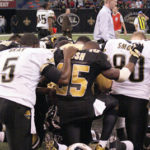
After organized worship, athletic competition is perhaps the oldest communal impulse known to mankind, and today sports and religion mirror each other as never before, experts say. Nowhere is that more evident than in the throngs of people at sporting mega-events like the Super Bowl, the Olympics or the World Cup. Fans dress up in their teams’ colors, chant their traditional songs and come together to celebrate the teams that they devote much of their time to following and discussing.
Background
Ancient civilizations elevated athletics to a spiritual plane, and Christianity, probably more than any other faith, continued that tradition. The Jewish world that Christianity sprang from disdained the mixing of worship and sports, as Judaism was concerned with distinguishing itself from the Greek and Roman polytheistic cultures. But experts say that as Christianity spread through the classical world its leaders naturally adapted Christian customs to that culture. That is evidenced, they say, by the many athletic images in the New Testament. (See I Corinthians 9:24-27, Galatians 2:2 and 5:7, Philippians 2:16 and 3:14, 2 Timothy 2:5 and 4:7, and Hebrews 12:1-2.)
But early Christians also rejected the blood sport of the Roman gladiator competitions, and of course Christians — as well as others — were often sacrificed at ancient “games.” So organized sport was not a Christian priority for centuries.
The emergence of leisure as a middle-class passion in the 19th century gave rise to organized sports at the same time that evangelical Protestantism was enjoying its heyday. The two came together in the “Muscular Christianity” movement in England and America that gave birth to the YMCA network and other efforts to join sport and faith.
The alliance only grew closer in the 20th century. The famous evangelist Billy Sunday was a former baseball player who used sports as a tool for conversion, and other evangelists have followed the same tack. The Promise Keepers men’s movement was founded in 1990 by a football coach in a football stadium and is in keeping with the American evangelical tradition of combining sports and faith to attract men to church. Catholic colleges also rode sports success to acceptance in the American mainstream.
The comfort level among Christians with sports is such that few think twice about watching — or playing — sports on Sunday, or on other holy days — activities that would have once been considered taboo. Contrast that with the continuing debates over whether Jewish players (such as the Dodgers’ Shawn Green in 2004) should play on holy days such as Yom Kippur, or the struggles that Muslim athletes have in fasting during Ramadan while continuing to compete.
While Christianity remains the principal arena for the mixing of sports and faith, American athletes are increasingly reflecting the introduction of other religious traditions. The ancient Hindu discipline of yoga has become a fitness craze for mind and body, while Eastern martial arts practices such as karate, kung fu and tai chi (which were started to get sedentary Buddhist monks into better shape) have become enormously popular as means to fitness and to athletic success.
Yet scholars, religious leaders and the general public are also wondering whether the intimate connections between religion and sports are such a good thing. Drug scandals, violence on the playing field and in the stands, recruiting violations and ethical lapses are clouding sports at every level, from the pros to college to kids’ leagues. Money seems to be the ultimate goal, and good sportsmanship often seems a thing of the past for fans as well as athletes — and sometimes, parents and coaches. And though religious traditions often praise athletes for their displays of skill and virtue, “sports” in the modern context often denotes a winner-take-all competitive mentality that is anathema to many religious teachings.
Why it matters
Experts say the symbiosis between religion and sports shows how deeply religion is embedded in American culture, and vice versa. Sportsplexes are used as worship centers, and pro athletes’ testimonies may be the most widely seen expressions of faith in the public square. Not every intersection of sports and religion is without contention, however. The 2004 death of Reggie White, a fearsome defensive lineman and full-time pastor since his retirement, reminded many of White’s controversial statements about the Bible and homosexuality. Some dislike the proliferation of prayers at school sporting events while others resent the intrusion of children’s weekend sports schedules into worship time. Yet the two impulses seem inextricable.
News articles and research
-
“A Quarter of Americans Say God Will Help Decide the Super Bowl”
Read a Jan. 13, 2013, story published by Slate about a survey released by the Public Religion Research Institute that found 27 percent of Americans think that a higher power plays some role in deciding who will win sporting events.
-
“Just How Much Is Sports Fandom Like Religion?”
Read a Jan. 29, 2013, article from The Atlantic that compares sports fans to members of a religious congregation.
-
“Where Religion and Sports Collide (And Sports Win)”
Read a Feb. 6, 2013, story published by BigThink.com that compares religion and the spectacle of sports.
-
“A Saudi Athlete’s Conflict—Rules or Religion”
Read a July 31, 2012, article from The Wall Street Journal about the struggles Muslim women face while competing in the Olympics.
-
“Tim Tebow talks about football and faith”
Read a June 21, 2013, interview with Tim Tebow about his football career and his faith. The NFL quarterback well-known for his game day face paint inscribed with Bible verses.
-
“Tim Tebow & Mom: Super Bowl ad 2010”
The 30-second Super Bowl ad that features Tim Tebow and his mother explaining how she rejected medical advice that she consider an abortion due to complications while pregnant with him was sponsored by Focus on the Family, a leading conservative Christian lobby. The controversy over the television spot was heightened because the network, CBS, said it has changed its policy against accepting advocacy advertising. Yet the network also rejected a gay-themed advertisement submitted for the 2010 Super Bowl, just as it had rejected a United Church of Christ ad in 2004 that highlighted the UCC’s welcome mat for homosexuals.
-
“Sports Fanatics: How Christians have succumbed to the sports culture — and what might be done about it”
The cover story of the February 2010 issue of Christianity Today is by author Shirl J. Hoffman and is titled “Sports Fanatics: How Christians have succumbed to the sports culture — and what might be done about it.” The article takes a critical look at the growing overlap between American Christianity and American sports.
-
“Amen, and a Foul”
Read the February 1, 2010, essay “Amen, and a Foul” by Mark Householder, president of Athletes in Action, an international sports ministry.
-
“Stay in the Struggle”
The February 1, 2010, piece “Stay in the Struggle” by Benjamin J. Chase and published by ChristianityToday.com argues that the competitive world of athletics is not so different from those of business, home and other environments. Chase is a former lacrosse player at Wheaton College.
-
“Flock Is Now a Fight Team in Some Ministries”
Read a Feb. 1, 2010, New York Times story, “Flock Is Now a Fight Team in Some Ministries,” about evangelical churches that are integrating martial arts and “extreme sports” into their ministries to attract young men and to help counter what many conservatives fear is a “feminization” of American Christianity.
-
“Is sport a religion?”
Read a Nov. 11, 2009, blog post, “Is sport a religion?” on the Psychology Today Web site.
-
“Praying for More Than a Win”
See an Oct. 14, 2006, Religion News Service story in The Washington Post, “Praying for More Than a Win,” about the growing number of sports franchises using religion to boost attendance.
-
“Onward Christian Shortstops”
See a June 1, 2006, Christianity Today essay by Collin Hansen, “Onward Christian Shortstops,” about efforts by the Colorado Rockies baseball team to attract Christian players whose character and faith the Rockies believe can help them win. The essay was prompted by a May 31, 2006, front-page story in USA Today called “Baseball’s Rockies seek revival on two levels.”
-
“Playing in the Zone: Exploring the Spiritual Dimensions of Sports”
Read an excerpt from Andrew Cooper’s book Playing in the Zone: Exploring the Spiritual Dimensions of Sports. It’s posted by Beliefnet.com.
-
“Spirit of the games”
Read a Beliefnet column from 2000 on how multiple religions see sports.
-
“Olympic Gifts of the Gods”
Read an Aug. 12, 2004, Beliefnet.com article on the religious origins of the Greek Olympics. It’s by Agapi Stassinopoulos, author of Gods and Goddesses in Love: Make the Myth a Reality for You.
-
“The Religious Roots of the Olympics”
Read a Sept. 18, 2009, Zenit.org story posted by Beliefnet.com about the religious roots of the modern Olympic creed.
-
“Tiger Woods and Buddhism”
Read a Feb. 19, 2010, article published on CBSNews.com about Tiger Woods’ return to Buddhism after his extra-marital affairs leaked to the press.
National sources
-
William Baker
William Baker is a professor emeritus of history at the University of Maine in Orono. He has written about Christ and the Olympics. His books include If Christ Came to the Olympics and Playing With God: Religion and Modern Sport. He argues that religion and sport have made peace with each other.
-
Christopher H. Evans
Christopher H. Evans is professor of history of Christianity and Methodist studies at Boston University School of Theology. He is co-editor of The Faith of 50 Million: Baseball, Religion and American Culture, a collection of essays on religious motifs in baseball.
-
Tom Krattenmaker
Tom Krattenmaker is director of communications for the Yale Divinity School in New Haven, Conn. A former reporter, he writes frequently on religion and public life for USA Today and Salon. His books include Onward Christian Athletes.
-
Herb Lusk
Pastor Herb Lusk is a former Philadelphia Eagles tailback who is thought to be the first NFL player to kneel and pray in the end zone after scoring a touchdown, in 1977. Since 1982 Lusk has headed the congregation at the Greater Exodus Baptist Church in Philadelphia.
-
R. Laurence Moore
R. Laurence Moore is a professor emeritus of American studies in the history department at Cornell University and author of Touchdown Jesus: The Mixing of Sacred and Secular in American History.
-
Michael Novak
Michael Novak, philosopher, theologian and public policy commentator at The American Enterprise Institute in Washington, DC, is the author of Questions about Liberation Theology (Paulist Press, 1991). He argued that by the late 1980s, liberation theology was in danger “of slipping into a backwater” because it had done very little to help the poor. He is also author of The Joy of Sports: End Zones, Bases, Baskets, Balls and the Consecration of the American Spirit. Many consider his book on sports and religion the first and best on the topic.
-
Frank Reich
Frank Reich is a former college and NFL star quarterback and from 2003 to 2006 was president of the Charlotte, N.C., campus of the Reformed Theological Seminary. He is now a motivational speaker and speaks about the relationship between prayer and athletic contests, often in the context of his own record of “miraculous” comeback victories. He lives in the San Diego area. Contact through Premiere Speakers Bureau.
-
Fellowship of Christian Athletes
The Fellowship of Christian Athletes, based in Kansas City, Mo., is the leading Christian organization for professional and student athletes. The ministry aims to evangelize through sports and has members sign a “Competitor’s Creed” to be on “Team Jesus Christ.” The FCA was founded in 1954, and its “huddles” meet regularly on nearly 8,000 junior high, high school and college campuses for prayer, Bible study and other activities. Les Steckel, a former National Football League coach, is president and CEO. Steckel was head coach of the Minnesota Vikings and was the offensive coordinator for two teams that reached the Super Bowl: the New England Patriots in 1986 and the Tennessee Titans in 2000.
Regional sources
In the Northeast
-
Warren Goldstein
Warren Goldstein teaches American history at the University of Hartford, where he chairs the history department. He is the author of Playing for Keeps: A History of Early Baseball, and he wrote an essay in the Nov. 1, 2003, Christian Century magazine titled, “Winning Isn’t Everything: Baseball as a Theological Discipline.”
-
Clifford Putney
Clifford Putney teaches American religious history at Bentley College in Waltham, Mass. He is the author of Muscular Christianity: Manhood and Sports in Protestant America, 1880-1920, regarded by many as a definitive work on the relationship between Protestantism and sports in America.
-
John Fitzsimmons Mahoney
John Fitzsimmons Mahoney, author of The Tao of the Jump Shot: An Eastern Approach to Life and Basketball, is a former high school basketball coach in New Jersey and author of books on Eastern religions who uses both sport and religion to illuminate each other.
-
Kent Berghuis
The Rev. Kent Berghuis is senior pastor at First Baptist Church of Oklahoma City, and an affiliate in theology at Palmer Theological Seminary in King of Prussia, Pa.
He co-authored a paper, with Matt Blackmon, titled “Would Jesus Play Texas Hold-Em? Reflections on Religion and the World Poker Tour.” The paper explores intersections between religion and the growing popular phenomenon of poker-playing, including a World Poker Tour pro who looks like and calls himself “Jesus,” and religious computer icons chosen to identify players on popular online poker sites such as PokerStars.com.
In the South
-
Shirl James Hoffman
Shirl James Hoffman is professor emeritus of kinesiology at the University of North Carolina at Greensboro. He wrote the Jan. 29, 2010, Christianity Today cover story “Sports Fanatics,” and he has a book, Good Game: Christianity and the Culture of Sports.
-
John Wilson
John Wilson is professor emeritus of sociology at Duke University in Durham, N.C. He has written articles on religion and marriage and also about religion and leisure. He has taught a class on sport and society.
-
Robert J. Higgs
Robert J. Higgs is the author of God in the Stadium: Sports and Religion in America (University Press of Kentucky, 1995) and co-author of An Unholy Alliance: The Sacred and Modern Sports (Mercer University Press, 2004). Contact via Mercer University Press.
-
Blake Burleson
Blake Burleson, senior lecturer in religion at Baylor University in Waco, Texas, has expertise in sports ethics and world religions.
-
Kirk Wakefield
Kirk Wakefield, professor of marketing at Baylor University in Waco, Texas, has expertise in sports ethics and marketing and fan behavior.
-
Donna Bowman
Donna Bowman is a professor of religious studies at the Honors College of the University of Central Arkansas and has written on the role of sports and faith.
At the American Academy of Religion meeting in 2002 she presented a paper titled “The Sacred Game: Representing Religious Experience in the Baseball Film,” which looked at movies from Bull Durham to Field of Dreams and included the Ken Burns documentary of baseball.
In the Midwest
-
James A. Mathisen
James A. Mathisen is a sociology professor emeritus at Wheaton College in Wheaton, Ill. where he taught a course in sport and sociology. He is the author of an essay, “American Sport as Folk Religion: Examining a Test of Its Strength” in From Season to Season: Sports as American Religion (2004). He also co-wrote the book Muscular Christianity: Evangelical Protestants and the Development of American Sport (1999).
-
John Rosengren
John Rosengren is a Minnesota writer and author of several books about sports and religion. His January 2004 essay in U.S. Catholic magazine, “Let Us Play,” examined the relationship of sports to sacramental faith. Rosengren also had an article in the January 2005 issue on the downside of Catholic schools’ catering to sports.
In the West
-
Joseph L. Price
Joseph L. Price is a professor of religious studies at Whittier College in Whittier, Calif. He wrote the article “Religion and American Popular Culture” for the Journal of the American Academy of Religion (1996) and has taught a course on religion and film. He is the author of the 2006 book Rounding the Bases: Baseball and Religion in America and editor of From Season to Season: Sports as American Religion, a collection of 14 essays, six of which Price wrote. They include “The Super Bowl as Religious Festival” and “The Final Four as Final Judgment: The Religious and Cultural Significance of the NCAA Basketball Championship.”
-
John Savant
John Savant is a professor emeritus at Dominican University of California and author of an essay, “The Saving Grace of Sport: Why we watch & play” in the Sept. 26, 2003, edition of Commonweal, an independent Catholic magazine.
Related source guides
-
‘Linsanity’ to ‘Timsanity’: Sports and faith go prime time
-
Body and soul: Faith-based fitness bulks up
-
World Cup, global religion: Resources on ‘football’ and faith
-
Religion and human rights: China and the 2008 Olympics
-
A guide to experts on religion and pop culture
-
Hindu chic? From the yoga craze to the movie ‘Eat Pray Love’